

music hall
 3
6.2
3
6.2

- noun
- /ˈmjuːzɪk hɔːl/
- Archaic
- In the early 20th century, many famous comedians started their careers in music halls across Britain.
- a raucous music hall
- British music hall
- music hall song
Loading YouTube…
Watch on YouTubeI was going to the Staples Center, Nokia, Madison by myself, Take two people with me, Radio City Music Hall.
- I was going to the Staples Center, Nokia, Madison by myself, Take two people with me, Radio City Music Hall.
Examples
-
The last performance I saw before COVID was Michael McIntyre live at Radio City Music Hall in New York.
-
Stanley, may I introduce to you Mr. Nobby Cook, one of our finest music hall comedians.
-
May I ask, sir, do you do this for a living in a music hall ?
-
one block over in what was then known as the Music Hall, later became the New Haven Opera House.
-
I'm going to the music hall and have a drink.
-
Tony pastor himself offered to sign her up for his music hall.
-
We hear a band inside playing a raucous music hall number.
Fiction book (1992) -
I wonder if she'd be inclined to drop in at the music hall with me one of these fine nights?
-
She's making a name for herself in the provincial music halls.
-
Of course, Kitty doesn't intend to stay in the music halls.
Synonyms
 553
1.0
553
1.0
A building where people go to see plays or movies

 1
7.5
1
7.5
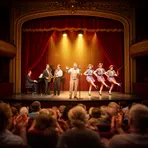
A theater that presents a series of short live acts like comedy, music, and dance
How Big
16
3.0
 19
2.5
19
2.5
- Archaic
3
6.2
835
1.2
- US
5
4.8
Surface Forms
Morphology
The compound 'music hall' is directly compositional: 'music' (musical performance) + 'hall' (a building for gatherings) yields a venue for musical/variety entertainment. While historical or genre-specific nuances (late 19th–early 20th-century variety shows) may not be known, a B1 learner who knows both constituents will readily infer the basic meaning.
Etymology
Music hall began as a simple description: a hall for music and small stage acts, where the audience watched singers, comedians and variety performances. Because these halls became famous in the late 1800s and early 1900s, the phrase now means 'a theater or place for popular entertainment'.