
muonic


 1
9.9
- adjective
- /mjuˈɒnɪk/
- Specialized
- A recent spectroscopic study of muonic hydrogen resulted in a new measurement of the proton root mean square (rms) charge radius.
- muonic hydrogen
- muonic components
Examples
-
In KASCADE, we measure the electromagnetic and muonic components of air showers separately.
Academic text (2018) -
In addition, it varies partly within the models if different shower observables taken from the electromagnetic, muonic, or hadronic components are used.
Academic text (2018) -
The muonic cold fusion reaction is a quantum mechanical reaction.
Fiction book (1999) -
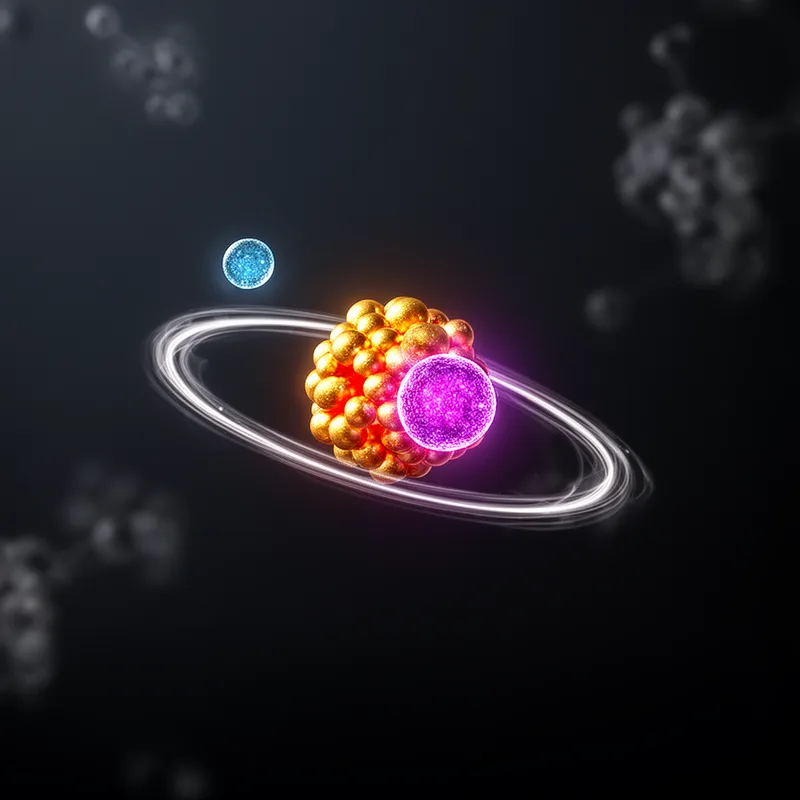
The muons take the place of electrons and combine with hydrogen to form muonic hydrogen.
Fiction book (1999) -
To produce muonic hydrogen, pulses from an intense, low-energy muon beam strike a hydrogen target.
Blog text (15) -
Because they are so small, when a muonic atom and a regular tritium or deuterium atom come close to each other, the mean fluctuations in the positions of their nuclei force a fusion reaction.
Fiction book (1999) -
In particular, we aim to measure the hyperfine splitting of the ground state energy level of muonic hydrogen by inducing a laser-stimulated singlet-to-triplet transition (3 S 1 ? 1 S 0), as suggested in previous works. 10, 11
Blog text (15) -
Its value is used together with the Rydberg constant in the calculations of bound-state QED involving hydrogen atoms as well as muonic hydrogen atoms that have a muon orbiting the nucleus rather than the electron.
Blog text (15) -
The study focused on the properties of muonic hydrogen, revealing new insights into subatomic interactions.
-
In experiments, the muonic particles were observed to affect the behavior of hydrogen nuclei significantly.
Surface Forms
Morphology
Etymology
The word muonic comes from the particle name made of the Greek letter mu (the Greek 'm') plus the particle ending -on, the same ending in electron. So, muonic means 'relating to muons', which is why it is used for atoms or experiments that involve those tiny particles.