
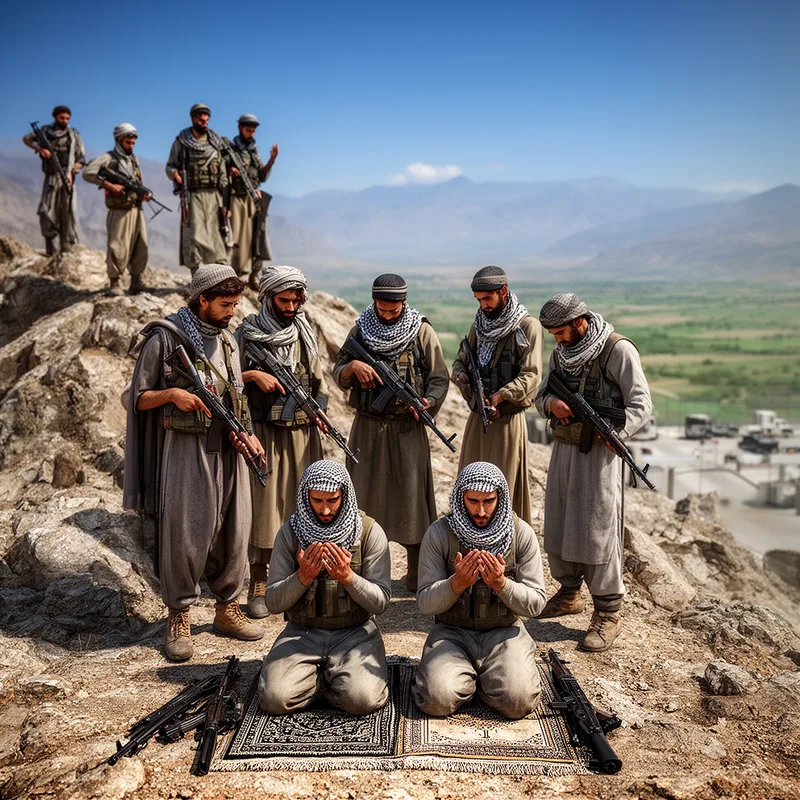
mujahedin


 1
9.9
1
9.9
- noun
- /ˌmuːdʒəˈhɛdɪn/
- The mujahedin fought fiercely to defend their homeland during the Soviet-Afghan War.
- mujahedin commander
- mujahedin leaders
- mujahedin groups
Examples
-
Washington also believed that the balance of power would change decisively in favor of the mujahedin once withdrawal was complete.
Academic text (1997) -
After the Soviet departure, the mujahedin formed the Afghan Interim Government in Islamabad.
Academic text (1997) -
What you see here are the mujahedin soldiers, holy warriors.
-
However, the mujahedin failed to establish a stable government.
Academic text (1997) -
Without the glue of a common enemy, the mujahedin turned their guns on each other in a brutal civil war.
Academic text (1997) -
As long as arms were reaching the mujahedin, other factors, such as the politics of Afghanistan, were regarded as secondary.
Academic text (1997) -
Additionally, the mujahedin leaders did not honor many aspects of their power-sharing agreement.
Academic text (1997) -
Mohammed Najibullah's overthrow in 1992 finally brought the anti-Soviet resistance groups, called the mujahedin, to power, but still the war did not end.
Academic text (1997) -
Many mujahedin were celebrated as heroes for their resistance against foreign invaders.
-
After the conflict, the mujahedin struggled to unite and form a stable government.
Synonyms
 12
9.9
12
9.9
Muslim people who fight in a holy war
 1
9.9
1
9.9
A group of Muslim fighters who use surprise attacks for religious or political reasons

Armed Muslim fighters who fight an army or government for religious reasons
Compounds

An Iranian political group from the 1960s that mixed Marxist and Islamic ideas and used violence
Surface Forms
Etymology
Mujahedin comes from Arabic and is the plural of mujahid, which means 'one who struggles' and comes from the same root as jihad ('struggle'). So mujahedin refers to groups of people who fight in that struggle.