
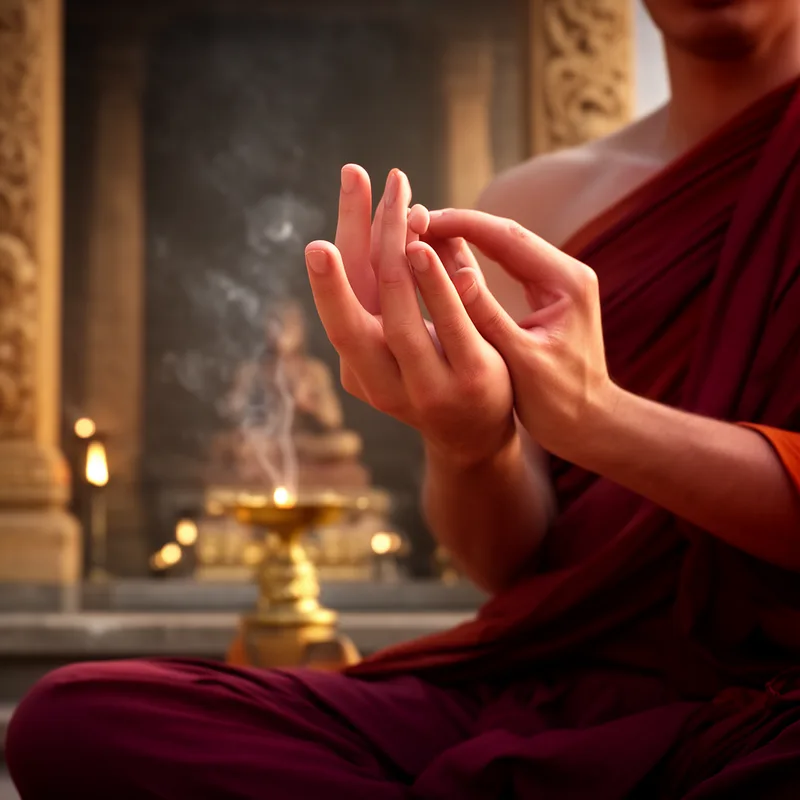
mudra


 1
9.9
- noun
- /ˈmuːdrə/
- Specialized
- She formed a mudra of gratitude, pressing her palms together in front of her heart.
- finger mudras
- mudras (sacred hand gestures)
- mudra hand
Loading YouTube…
Watch on YouTubeIt's this figure and he's got his hands in Anjali mudra, which is the the, the mudra respect, paying respect.
- It's this figure and he's got his hands in Anjali mudra, which is the the, the mudra respect, paying respect.
- You can either do it momentarily or you can place your hand there and leave it there, or you can form a prayer mudra and hold it there.
- The man was sitting there like a Buddhist statue with his eyes closed and his hands in a mudra.
- You know, when we're doing some of our mudras, you know, she'll, she'll very like over the sound of the, the music and the chanting, she'll say, like, you're beautiful.
- So yeah, it has some mudras that go with it that I won't do.
Examples
-
It's this figure and he's got his hands in Anjali mudra, which is the the, the mudra respect, paying respect.
-
I studied his face, the face of a listening poet, as his other hand shifted into a mudra—two fingers and thumb, something like holding a teacup—that could stand for "confident quiet waiting."
Blog text (1) -
The mudra of dispelling fear.
Fiction book (2001) -
This is a mudra, sacred sign language: a blessing, the granting
Fiction book (1993) -
You can either do it momentarily, or you can place your hand there and leave it there, or you can form a prayer mudra and hold it there.
-
One of her hands is broken, but two others hold a lotus and a water jar (kamandalu) respectively, and the last is posed in abhaya mudra (the "fear not" hand gesture).
Academic text (2008) -
More specifically, this and other works, such as Unifurl, refer to mudras, the signs and gestures made with hands and fingers that are said to symbolize the enlightenment and vows of Buddhas and bodhisattvas.
Academic text (2004) -
During the ceremony, the monk held his hands in a mudra that symbolized peace and harmony.
-
In many traditional dances, performers use a mudra to express emotions and tell stories.
Surface Forms
Etymology
Mudra comes from Sanskrit mudra, which originally meant 'seal' or 'sign'. Think of a mudra like a hand 'stamp' — a small sign used in dance, art, and prayer to show a spiritual meaning.