
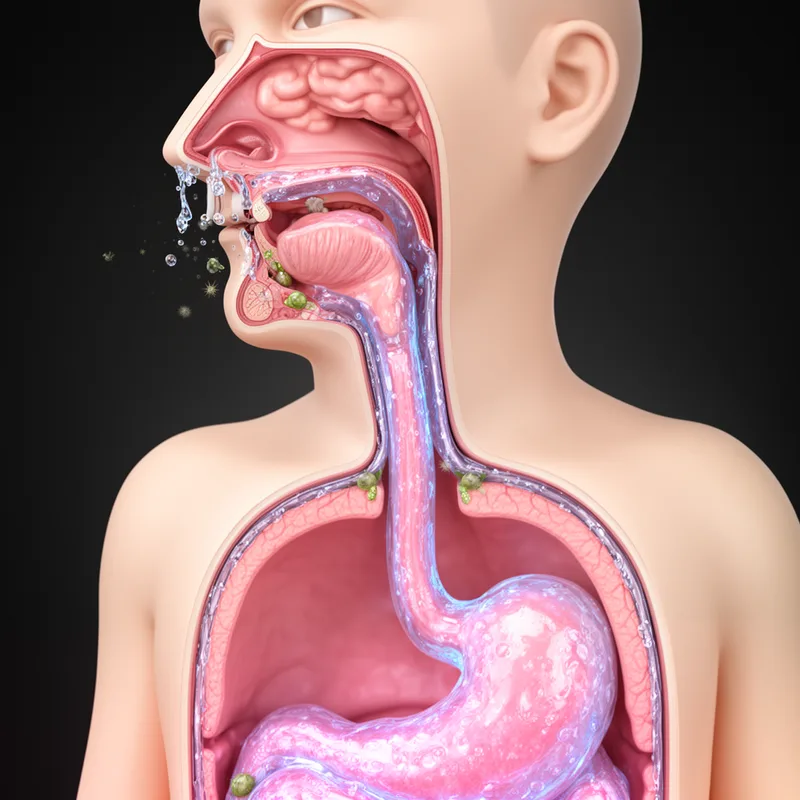
mucous secretion
- noun
- /ˈmjuːkəs sɪˈkriːʃən/
- Specialized
- The doctor noted an increase in mucous secretion as a sign of the patient's allergies worsening.
Examples
-
During a cold, the body often produces excess mucous secretion to help trap viruses and bacteria.
-
In addition, mucous secretion can avoid different stimuli due to an increase in distance between them and the airway mucosa, as well as due to a decrease in stimuli concentration on the mucosal surface.
Academic text (2007) -
Bronchial hyper-reactivity, epithelial destruction, mucous secretion, airway obstruction, oxygenic stress, etc. may be instruments of this goal.
Academic text (2007) -
Mucous secretion plays a crucial role in keeping the respiratory system moist and protected from pathogens.
Synonyms

 31
3.4
31
3.4

A thick, sticky liquid made in the nose, throat, and gut that protects and moistens them
How Viscous
- Specialized

- Specialized
17
4.8
Surface Forms
Morphology
The noun is compositionally built from the adjective 'mucous' (relating to mucus/mucous membranes) and 'secretion' (a substance discharged by a gland), so the meaning — a glandular/mucus-related discharge — is directly derivable from the parts. Although somewhat medical/technical in register, the semantic relation is regular and cross-linguistically parallel (e.g. Spanish 'secreción mucosa'), so a B1 learner who knows both constituents will understand it.
Etymology
Mucous secretion shows a simple picture: mucous is the sticky layer and secretion is something the body makes. This sticky fluid covers the inside of the nose, mouth, and gut to 'protect' and 'moisten' them, so the phrase means the protective fluid the body makes.