
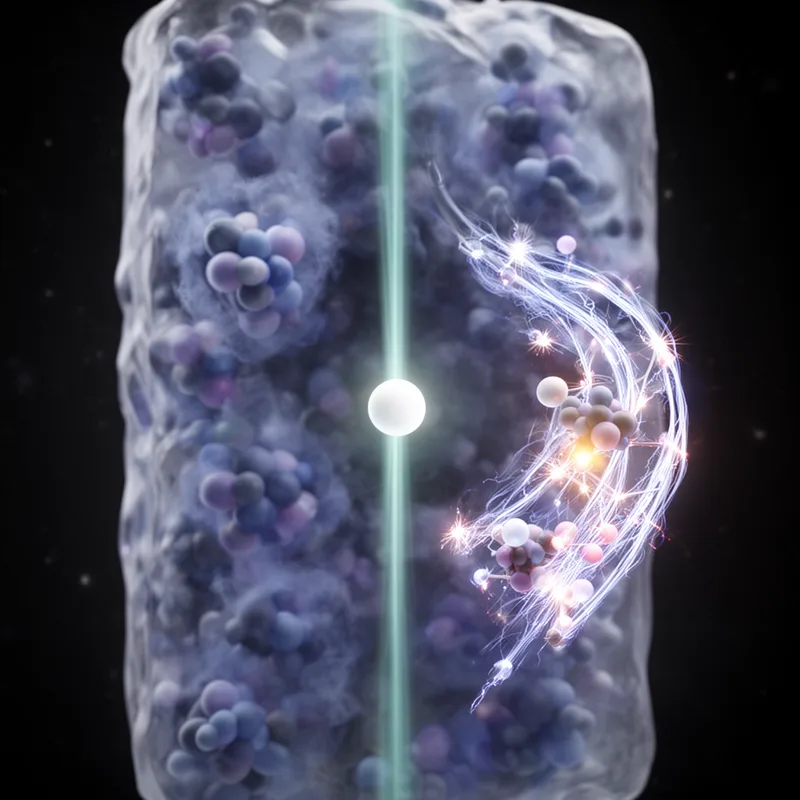
mu neutrino
- noun
- Specialized
- Scientists detected the mu neutrino to investigate its properties in high-energy experiments.
Loading YouTube…
Watch on YouTubeIf it decayed into instead of an electron, a MU particle, it would make a a MU neutrino.
- If it decayed into instead of an electron, a MU particle, it would make a a MU neutrino.
Examples
-
The mu neutrino is a fundamental particle in physics.
-
Each mu neutrino is electrically neutral and interacts only via the weak nuclear force.
-
The mu neutrino is produced when cosmic rays interact with the earth's atmosphere.
-
Scientists study mu neutrinos to understand particle interactions.
-
In particle physics, a mu neutrino is produced during certain types of decay processes involving muons.
-
Researchers are studying the behavior of a mu neutrino to better understand its interactions with matter.
-
The detection of a mu neutrino can provide valuable insights into the fundamental properties of the universe.
Synonyms
A very light particle with no electric charge related to the muon
Surface Forms
Morphology
The phrase is a straightforward technical compound: the modifier 'mu' (a label/Greek letter denoting the muon flavour) specifies a subtype of 'neutrino', so the overall meaning (‘the neutrino associated with the muon’) is compositionally derived from its parts. This naming pattern for particle types is regular in scientific English (and mirrored across other languages), so a learner who knows both constituents can infer the MWE's sense.
Etymology
Mu neutrino gets its name from the Greek letter mu, which labels the related particle the muon, and the word neutrino, meaning 'small neutral one'. So, mu neutrino simply means 'the neutrino that belongs with the muon'.

