

mouse-ear chickweed
- noun
- /ˈmaʊsˌɪr ˈʧɪkˌwiːd/
- She could identify mouse-ear chickweed by its tiny white blossoms and fuzzy leaves.
Examples
-
The garden was quickly overrun by mouse-ear chickweed after the warm spring rains.
-
Many people overlook mouse-ear chickweed as a weed.
-
A patch of mouse-ear chickweed grew along the edge of the forest path, mixed with other wildflowers.
-
The garden is full of mouse-ear chickweed.
-
A patch of mouse-ear chickweed grew along the edge of the forest path, mixed with other wildflowers.
-
She could identify mouse-ear chickweed by its tiny white blossoms and fuzzy leaves.
-
The garden was quickly overrun by mouse-ear chickweed after the warm spring rains.
Synonyms

 1
8.1
1
8.1

A small plant that grows close to the ground and is often a weed in gardens
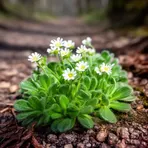
A small plant with white flowers and soft hairy leaves like a mouse ear

A low plant with tiny soft leaves that look like a mouse's ear
Surface Forms
Morphology
mouse-ear + chickweed
This is a descriptive compound: 'mouse-ear' (mouse + ear) modifies 'chickweed' to indicate a chickweed with leaves resembling a mouse's ear. A B1 learner who knows 'mouse', 'ear', and 'chickweed' can readily infer this literal, perceptual meaning, so the expression is transparent.
Etymology
Mouse-ear chickweed probably gets its name from the plant's tiny, fuzzy leaves: the small rounded leaves look like a mouse-ear, and the plant itself is a low wild plant called chickweed. So the name reminds you it is 'a small, low-growing wild plant with tiny white flowers and hairy leaves'.