

motor nerve


 1
4.5
1
4.5
- noun
- /ˈmoʊtər nɜrv/
- Specialized
- Someone struck by a Taser experiences stimulation of his or her sensory nerves and motor nerves, resulting in strong involuntary muscle contractions.
- femoral motor nerve
- motor nerve branch
- motor nerve fibers innervating
Examples
-
"At Southwestern Orthopaedic, a consultant told him that key motor nerves had been ripped out of his spine.
Fiction book (1999) -
The position of the moving motor nerve relative to the stationary hand-held electrode or probe changes as the muscle contracts, resulting in a degradation of the stimulated response.
Academic text (2001) -
Just a simple motor nerve reflex.
-
Proximity to femoral motor nerve
Academic text (2012) -
Surface electrodes are placed on the skin surface and deliver electrical charge to the motor nerve transcutaneously.
Academic text (2001) -
Motor neurone disease causes progressive damage to motor nerves, leading to loss of muscle strength and bulk and affecting movement, breathing, and swallowing.
Academic text (2011) -
That response depends on nerve reflexes, through which a center in the brain receives sensory information about heat and then uses that information to send out signals on motor nerves controlling the sweat glands.
Academic text (1991) -
Pathogenetic antibodies could be taken up by motor nerve endings and, by retrograde transport through the axons, could damage lower motor neurons.
Academic text (2000) -
Because their stimulating surfaces lie closer to the motor nerve of the desired muscles, they can produce contractions more efficiently (with lower currents) and with greater selectivity than surface electrodes.
Academic text (2001) -
Damage to a motor nerve can result in muscle weakness or paralysis of the affected area.
Synonyms
 2
3.9
2
3.9
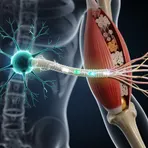
A nerve cell that sends signals from the brain or spinal cord to a muscle to make it move
 1
8.4
1
8.4
A nerve cell that sends signals from the brain or spinal cord to muscles to make them move
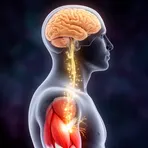
A thin thread that carries messages from the brain to a muscle to make it move
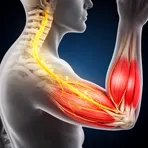
A nerve that sends signals from the brain or spinal cord to muscles to make them move
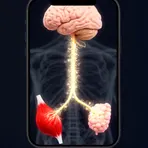
A nerve that carries signals from the brain or spinal cord to muscles and glands
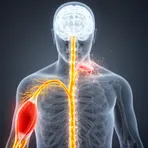
A nerve that sends signals from the brain and spinal cord to muscles or glands
Surface Forms
Morphology
The phrase is directly compositional: 'motor' (relating to movement or movement control) modifies 'nerve' (a bundle of fibers), yielding a nerve that conveys impulses for movement. This is a standard, cross-linguistic technical noun phrase so a B1 learner who knows both constituents can reliably infer the medical meaning.
Etymology
Motor nerve combines motor (a 'mover') and nerve, giving a clear picture of a pathway that makes things move; imagine a wire that carries an order from the brain to a muscle. So, a motor nerve is a nerve that 'carries orders' to muscles, which is why it means 'a nerve that makes muscles act'.