
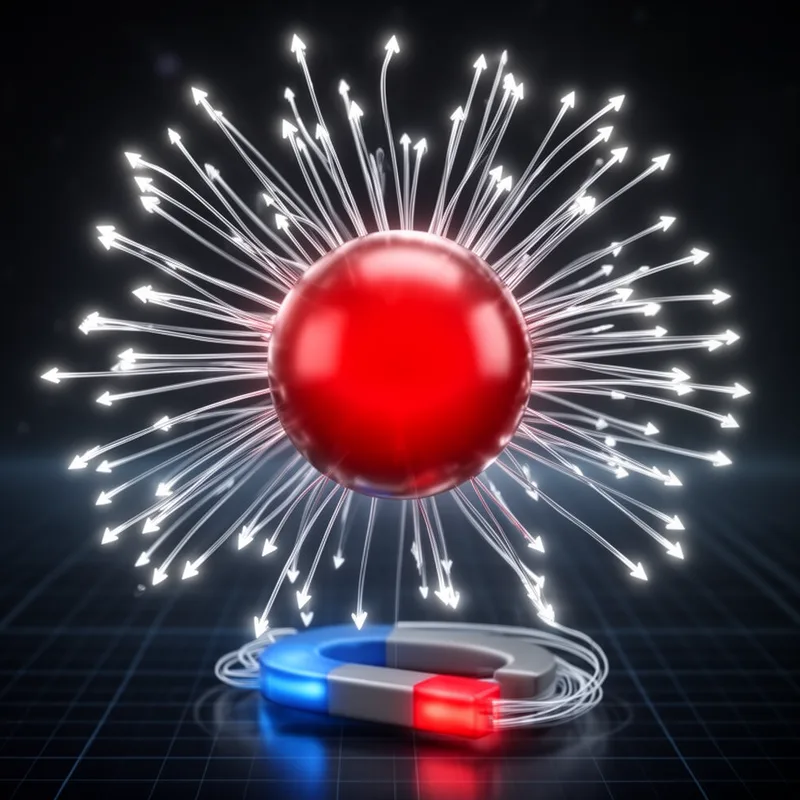
monopole
 1
9.9
1
9.9

- noun
- /ˈmɒnəˌpoʊl/
- Specialized
- Theoretical wizard Paul Dirac first predicted the monopole's existence more than half a century ago when he contemplated nature's many symmetries.
- magnetic monopole
- monopole particle
- existence of monopoles
Loading YouTube…
Watch on YouTubeI I don't think there's any chance of seeing monopoles.
- I I don't think there's any chance of seeing monopoles.
- I will try to cover magnetic monopoles this quarter and discuss how they fit into this picture.
- And since most unified field theories contain monopoles, this would be a strong clue that unification of the forces is indeed the right track.
- So he was focused at one point on the what's called the missing monopole problem.
- And the monopole problem of where are all these leftover high energy relics?
Examples
-
"One perpetual contender is the monopole, a particle conceived as a solitary magnetic pole, either a north or a south, but not both."
Academic text (1993) -
Much search has been pursued to find a "monopole," but I don't hear of any discoveries.
Blog text (21) -
The answer is, the answer is that the right model for a monopole is the solenoid.
-
You could have monopoles, which are cosmic points.
-
Because if you have a degree in physics, you know there are no magnetic monopoles, at least we've not found any yet.
-
Monopoles naturally arise in grand unified theories as well.
Academic text (1993) -
An example of a nearly zero-dimensional object, magnetic monopoles are point particles (i.e., they have no internal structure or excited states) and are a result of broken spherical symmetry.
Academic text (2005) -
In theoretical physics, a monopole is a particle that possesses only one magnetic pole, unlike traditional magnets.
-
Scientists have long debated the existence of a magnetic monopole, as none have been observed in experiments.
-
Researchers propose that a monopole could exist based on certain theories about the fundamental forces of nature.
Synonyms


 1
9.9
1
9.9
A hypothetical particle with only one magnetic pole, north or south
Compounds
- Specialized
1
9.9
A hypothetical particle with only one magnetic pole, north or south
- Specialized
A tiny effect in some crystals that looks like a single magnetic pole
Surface Forms
Morphology
Etymology
Monopole comes from mono- meaning 'one' and pole meaning the 'end' or 'point', like the North Pole. A helpful image is a magnetic monopole having only a North pole and no South pole, which is why it is an idea scientists have not seen in nature.