
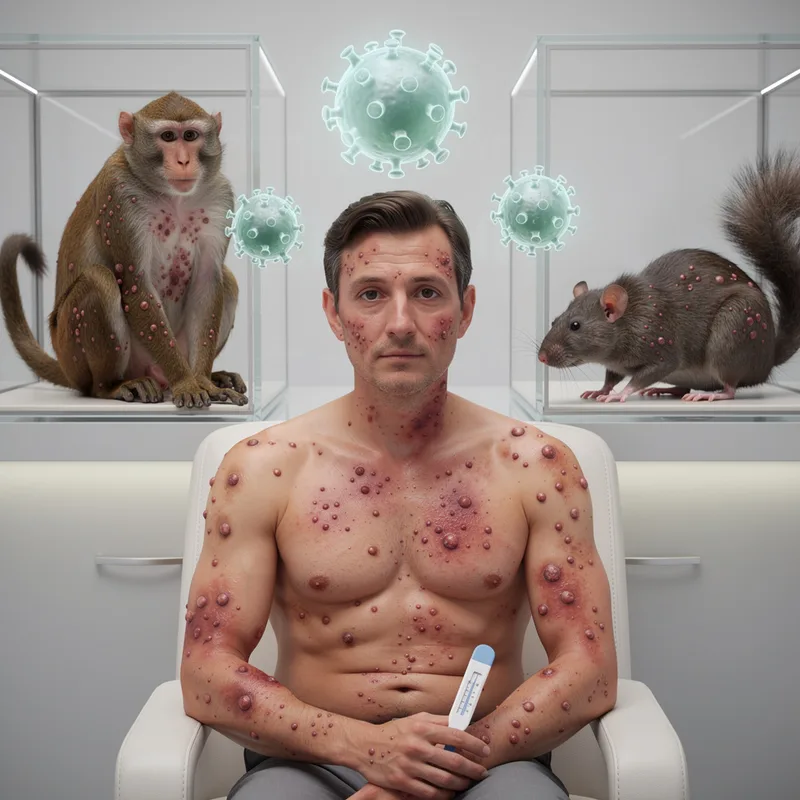
monkeypox
 2
5.3

- noun
- /ˈmʌŋkiˌpɑks/
- Specialized
- Health officials confirmed that a patient has been diagnosed with monkeypox after returning from an affected area.
- monkeypox virus
- monkeypox disease
- human monkeypox
Examples
-
Although active disease surveillance has assessed monkeypox disease prevalence and geographic range, information about virus diversity is lacking.
Academic text (2014) -
Monkeypox virus is a zoonotic virus endemic to Central Africa.
Academic text (2014) -
Within about a month, 71 human cases of monkeypox in six Midwestern states had been reported to the CDC; luckily, no one died.
Academic text (2005) -
(Wildlife health experts and human health workers in central Africa have long associated human monkeypox infections with rodent and squirrel contact.)
Academic text (2005) -
In 2003, an outbreak of monkeypox in the midwestern United States revealed the propensity for transmission to MPXV-naive populations.
Academic text (2014) -
Recent reports suggest that human-to-human transmission of the genomic variability of the Monkeypox virus, DRC of MPXV is increasing (20, 21).
Academic text (2014) -
It was soon discovered that a prairie dog dealer in Wisconsin had let a number of his animals mix with rodents recently imported from Ghana that happened to be carrying the monkeypox virus.
Academic text (2005) -
From November 2005 through November 2007, a total of 760 cases of human monkeypox in the Sankuru District, DRC, were identified by active disease surveillance and confirmed by quantitative real-time PCR (20).
Academic text (2014) -
The recent outbreak of monkeypox has raised concerns among health officials about its transmission to humans.
-
Symptoms of monkeypox include fever, rash, and skin lesions, similar to those caused by smallpox.
Surface Forms
Morphology
Etymology
Monkeypox comes from the two parts monkey and pox, because the illness was first seen in monkeys and pox means a disease with 'spots' or 'sores'. So, the name points to a pox disease linked to monkeys and to the skin rash it causes.