

moneyer
9.9
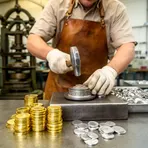
A person who makes coins for a ruler or country
- noun
- /ˈmʌniər/
- Archaic
:
monedero
- In ancient Rome, a moneyer had the important job of minting coins for commerce.
Examples
-
On the top, the denarius of the moneyer Trio.
Academic text (1995) -
On the right, a silver denarius bearing the name of the moneyer Publius Petronius Turpilianus.
Academic text (1995) -
The crescent Moon also appears on a silver denarius struck by the Roman moneyer Lucius Lucretius Trio around 74 B.C. (see figure 7).
Academic text (1995) -
The moneyer carefully inspected each coin before sealing the bags for distribution.
-
During the festival, the moneyer showcased newly minted coins to the crowd.
Synonyms

Surface Forms
Morphology
Etymology
Moneyer comes from money plus the agent ending -er, literally 'one who makes money', and money itself comes from the Latin moneta, the name of a Roman temple where coins were made and the origin of the idea of a 'mint'. So a moneyer was the person who made or stamped the coins.

