
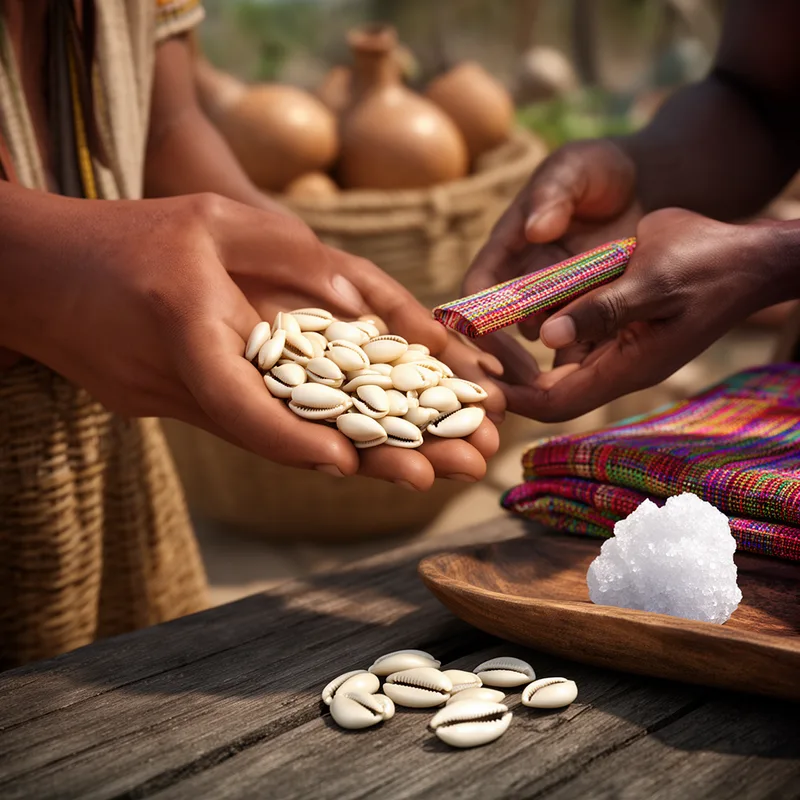
money cowrie
- noun
- /ˈmʌni ˈkaʊri/
- Archaic
- In some cultures, the money cowrie symbolized wealth and status.
Examples
-
The ancient traders exchanged money cowries for goods such as salt and fabric.
-
The money cowrie was widely used in ancient trade.
-
A collection of money cowrie shells was uncovered at the archaeological site.
-
Many cultures in Africa valued the money cowrie as currency.
-
In ancient trading cultures, the money cowrie served as a common form of currency.
-
Many African communities used money cowries in transactions before modern currency.
-
The value of the money cowrie was recognized in various countries across the southern Pacific.
Synonyms

 1
9.9
1
9.9

A small shiny sea shell used as decoration and once used as money


 1
9.1
1
9.1
A small shiny sea shell from tropical seas often used as money or jewelry

A small glossy sea shell used as money in parts of Africa and the Pacific
Surface Forms
Morphology
The compound is directly composed from 'money' (currency) and 'cowrie' (a shell historically used as form of payment), so a B1 learner who knows both constituents can infer it denotes a cowrie used as money. This noun-noun compositional pattern is straightforward and cross-linguistically common, making the meaning predictable without prior exposure.
Etymology
Money cowrie comes from small sea shells called cowrie that people in parts of Africa and the southern Pacific once 'used as money'. Imagine shiny shells passed like coins to buy food or cloth, and that picture explains why the name means a cowrie shell used as money.