
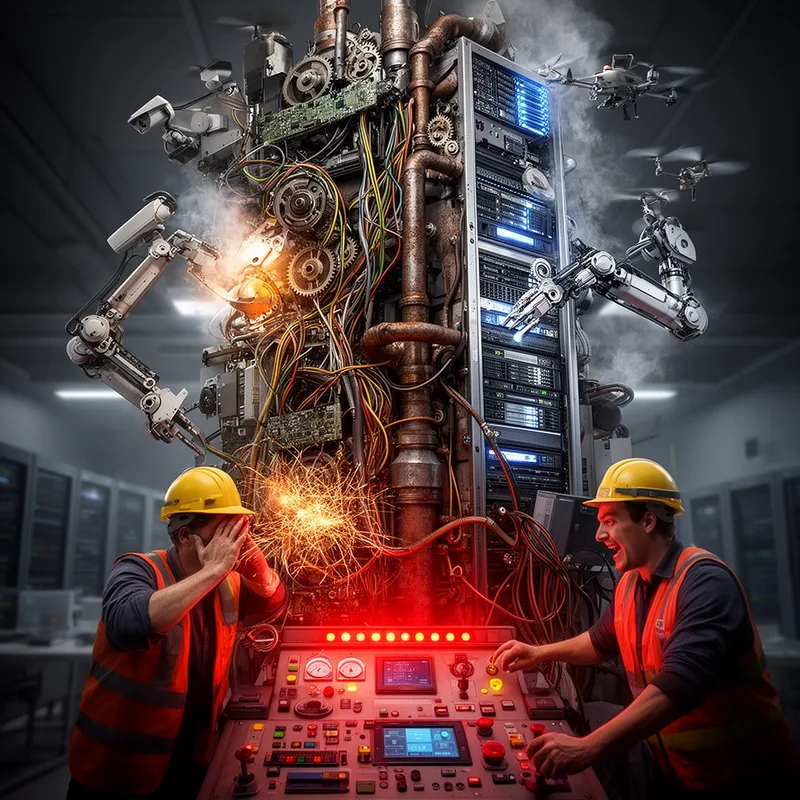
modern-day Frankenstein
- noun
- /ˈmɒdərn deɪ ˈfræŋkənstaɪn/
- Literature
- The government's new facial-recognition system is a modern-day Frankenstein, assembled from incompatible modules.
Examples
-
Startups worry their AI prototype could become a modern-day Frankenstein if deployed without proper safety checks.
-
They called the sprawling platform of plugins a modern-day Frankenstein that threatened users' privacy.
-
Is this a modern-day Frankenstein?
-
The new AI system is a true modern-day Frankenstein!
-
The company's latest invention was deemed a modern-day Frankenstein, combining old technology in ways that many experts found alarming.
-
Engineers cautioned that the new drone, a modern-day Frankenstein, raised ethical concerns due to its unpredictable behavior.
-
Critics labeled the poorly planned urban development project a modern-day Frankenstein, composed of mismatched structures that posed safety risks.
Synonyms

 11
9.4
11
9.4

A machine made to look and act like a human
 1
7.8
1
7.8
A creature that a scientist brings to life in Mary Shelley's novel


 1
8.2
1
8.2
A creation that escapes its maker and causes harm
How Dangerous
- Literature

Surface Forms
Morphology
modern-day + Frankenstein
The phrase combines the adjective 'modern-day' (contemporary) with the figurative noun 'Frankenstein' (a creation that harms its maker), so the overall sense of a contemporary dangerous or uncontrollable creation is directly derivable from the parts. This straightforward adjective–noun composition is a common, cross-linguistic pattern, so a B1 learner who knows both constituents would likely infer the MWE's meaning.
Etymology
Modern-day Frankenstein comes from the same story where a man built a monster from many different body parts that did not fit well together. That's why people use modern-day Frankenstein for a machine or project made from mixed parts that becomes 'dangerous' or hard to control.