
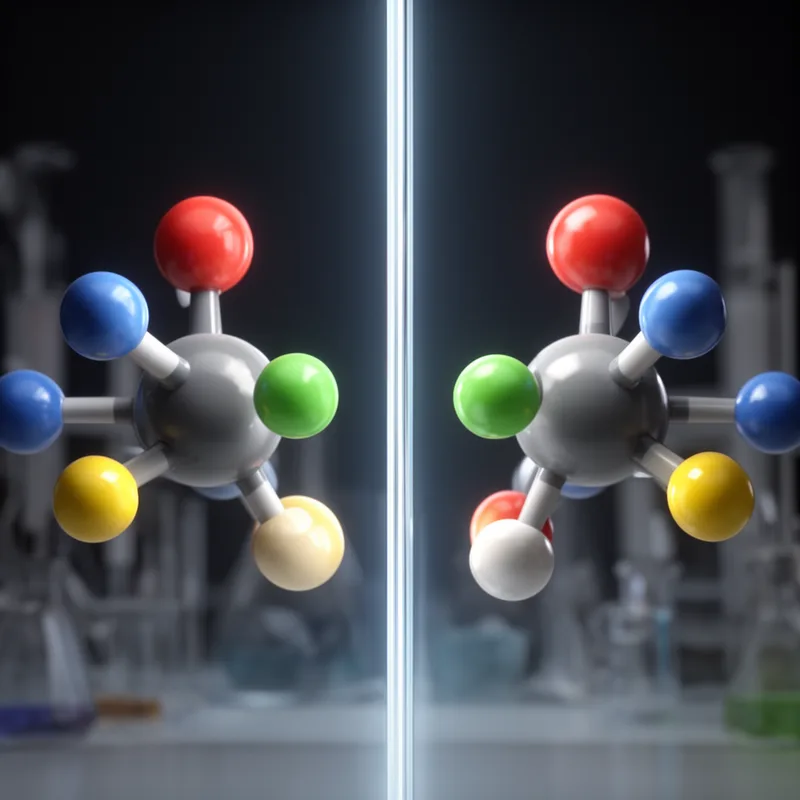
mirror-image relation
- noun
- /ˈmɪrər ˈɪmɪdʒ rɪˈleɪʃən/
- Specialized
- In organic chemistry, amino acids often exhibit a mirror-image relation to one another, which determines their biological activity.
Examples
-
The concept of a mirror-image relation is crucial in understanding enantiomers in stereochemistry.
-
Some minerals can form crystals that display a mirror-image relation, making them optical isomers.
-
The two molecules exhibit a clear mirror-image relation.
-
In chemistry, mirror-image relations are crucial for understanding chirality.
-
In organic chemistry, amino acids often exhibit a mirror-image relation to one another, which determines their biological activity.
-
Some minerals can form crystals that display a mirror-image relation, making them optical isomers.
-
The concept of a mirror-image relation is essential for understanding how certain compounds interact in stereochemistry.
Synonyms

A property of being mirror images that cannot be placed on top of each other, like left and right hands
Surface Forms
Morphology
mirror-image + relation
The phrase is transparently built from 'mirror-image' (an exact reflection) plus 'relation' (a connection), so a learner who knows those words can infer it means a relationship of exact reflection between items. Although used in technical contexts (chirality/crystals), the compositional logic is clear and common across languages, so a B1 learner would likely understand the sense.
Etymology
Mirror-image relation comes from the simple picture of a mirror and an image: two things that are exact reflections of each other, like a left and a right hand. So in chemistry or crystals it means two molecules or shapes that are 'mirror' copies of each other and often behave as opposite versions.

