
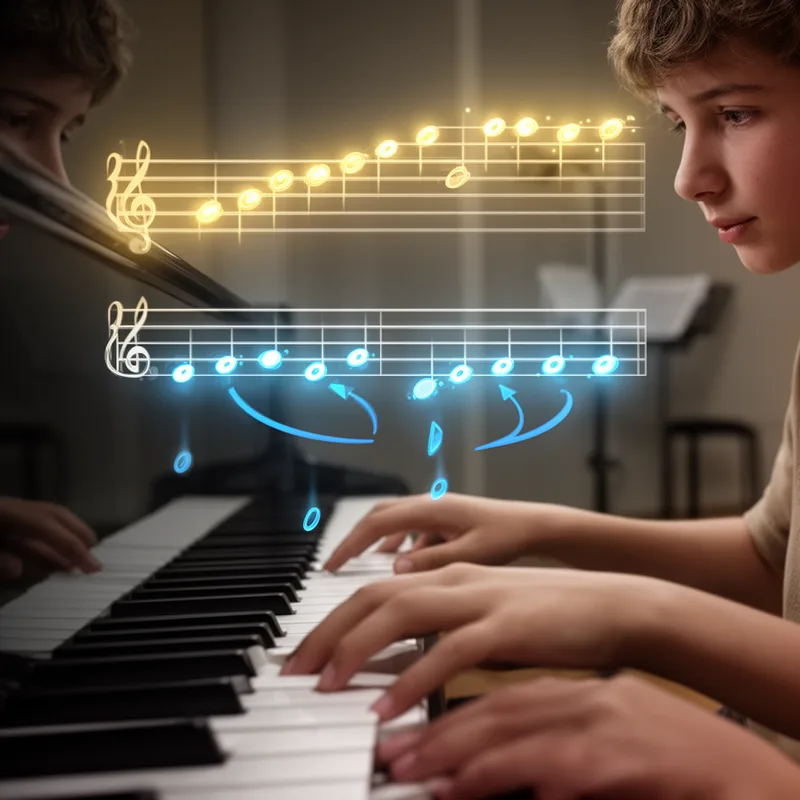
minor scale


 1
4.6
1
4.6
- noun
- /ˈmaɪnər skeɪl/
- Specialized
- The sound of the E minor scale evokes a sense of melancholy in many compositions.
- natural minor scale
- minor scale and major scales
Loading YouTube…
Watch on YouTubeOK, this is a mode of the melodic minor scale.
- OK, this is a mode of the melodic minor scale.
Examples
-
You will play the B-flat minor scale with both hands.
Fiction book (1993) -
Have the students start with a D natural minor scale and let them rehearse the ostinato pattern learned earlier.
Academic text (2001) -
Now let's try the A minor scale.
Fiction book (1999) -
Well, the A minor scale is the only minor scale that only has white keys.
-
Students may play major and minor scales.
Academic text (2014) -
Cecile attempts the A minor scale, messing up badly.
Fiction book (1999) -
For these beginning students of jazz improvisation, the performance of all major and minor scales is critical in establishing a foundation of sounds "under the fingers" and "in the ears."
Academic text (1991) -
While Dalcroze solfège classes will consider all forms of the minor, the do-to-do minor scale is sung in the harmonic form to distinguish it from its relative major.
Academic text (2011) -
In music class, we learned how to play the C minor scale on the piano.
-
When practicing for the concert, she focused on mastering the F sharp minor scale.
Synonyms
 2
5.9
2
5.9
A set of notes that sounds sad or serious

A set of notes used in Western music that makes a piece sound sad
Antonyms
- Specialized
1
3.7
A set of seven notes with whole steps except half steps between the third and fourth and seventh and eighth
How Bright
- Specialized
1
3.7

- Specialized
1
4.6
Surface Forms
Morphology
The compound is compositionally interpretable: 'minor' modifies 'scale', so a learner who knows 'scale' (series of notes) and the common sense of 'minor' (darker/lesser quality) can infer it denotes a type of musical scale with a sadder or darker sound. However, the specific technical pattern of intervals (lowered 3rd, 6th, 7th) is specialist music knowledge, so the general sense is accessible but the detailed meaning is not fully predictable without musical background; cross-linguistic equivalents (e.g., Spanish 'escala menor') make the basic sense more transparent.
Etymology
Minor scale: The musical term minor scale comes from calling some notes minor (literally 'smaller' or 'lower') than in a major scale, so the important notes are lower. Those lower notes give a darker, more 'sad' sound, which is why the minor scale is used to make music feel sad or serious.