

minestrone
 4
4.9
4
4.9

- noun
- /ˌmɪnəˈstroʊni/
- We've got some vegetable minestrone and some breadsticks.
- minestrone soup
Loading YouTube…
Watch on YouTubeThey're just going to make minestrone in there, gum up the pipes with white beans.
- They're just going to make minestrone in there, gum up the pipes with white beans.
- Now that I've I've thoroughly picked apart your your minestrone diet.
Examples
-
The minestrone was her own recipe, never the same twice.
Fiction book (1997) -
At the restaurant, I ordered a steaming bowl of minestrone topped with fresh basil.
-
Make me a bowl of minestrone!
-
So we decided to stop and I saw that they had minestrone soup on the menu and I thought that sounded really good.
-
Marianne's minestrone was the most delicious soup.
Fiction book (1997) -
There was homemade minestrone on the stove and a moldy-looking cheese laid out on a board.
Fiction book (1998) -
We are getting a sad gray mist today, and I began the morning making minestrone; I felt we needed some nice homemade soup for dinner tonight.
Blog text (6) -
By the time I get home, they are done and ready to add to whatever I am making for dinner -- minestrone, black beans and rice, chili, enchiladas... the list goes on and on.
Blog text (6) -
The ice coating the old man's shoulders is melting into the tweed, and he orders minestrone to warm himself.
Fiction book (1997) -
For our family gathering, I prepared a hearty minestrone filled with beans and pasta.
Synonyms
 5
1.0
5
1.0
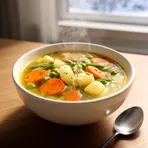
A hot dish of vegetables like carrots and potatoes cooked in a tasty liquid

A simple Italian soup made with vegetables and often with pasta or rice
How Thick

Surface Forms
Etymology
Minestrone comes from the Italian minestra, meaning 'soup', from minestrare 'to serve', and is from the same root as minister 'servant'. The ending -one makes it larger, so minestrone literally means a 'large served soup', which explains why the word refers to the thick, hearty Italian soup we eat today.