
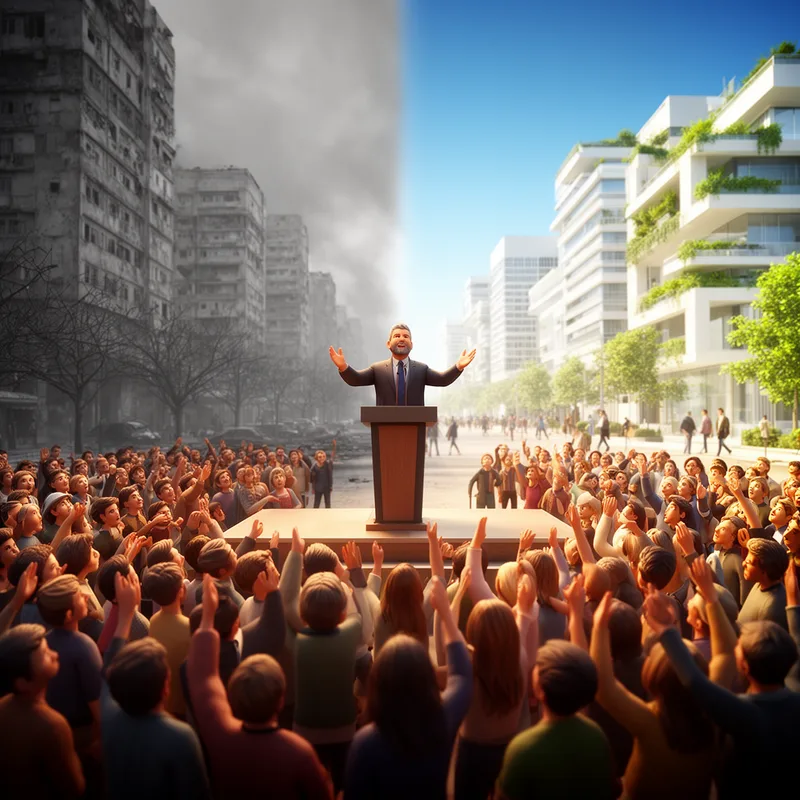
millennialism


 1
9.5
- noun
- /mɪˈlɛn.i.əl.ɪ.zəm/
- This fervor, and what would more fashionably be termed today a discourse of millennialism, was evident not only among Puritans in New England and other Reformation communities such as Holland, England, and Scotland but in other societies as well.
Examples
-
Many followers of millennialism believe that significant changes in society will soon lead to a golden age of peace and harmony.
-
On the one hand, millennialism was definitely rejected as a mode of articulating collective national identity, social action, or the legitimation of authority.
Academic text (1991) -
This is not unrelated to the new forms of millennialism, new sorts of theocracy, that have emerged in Africa and elsewhere in inverse proportion to the waning of civil governance, secure citizenship, and regular work.
Academic text (2010) -
Most importantly, from the comparative perspective, one of the central areas where this idiom was seen to be at work was in the developing rhetoric of civil (or in E. L. Tuveson's term, "Whig") millennialism during the Seven Years War (in the 1750s) and later during the Revolutionary period.
Academic text (1991) -
The notion of millennialism has influenced various political movements that seek radical transformations in the current system.
-
In discussions about politics, millennialism often refers to the hope for a future utopia brought about by revolutionary change.
Synonyms
 1
9.9
Belief that society will change completely, often by a future thousand-year rule of Christ
 1
9.2
Support for deep change in politics or society
Antonyms


Surface Forms
Morphology
millennialism = millennial (semi-transparent) = millennium + al + ism
The word is built clearly from 'millennial' plus '-ism', but the modern ideological sense is somewhat specialized.
Etymology
Millennialism comes from millennium, a word for a 'thousand-year' time that later came to mean a coming 'new age' or era. So millennialism can also mean the belief that a sudden, big change will bring a new, ideal time in society or politics.