
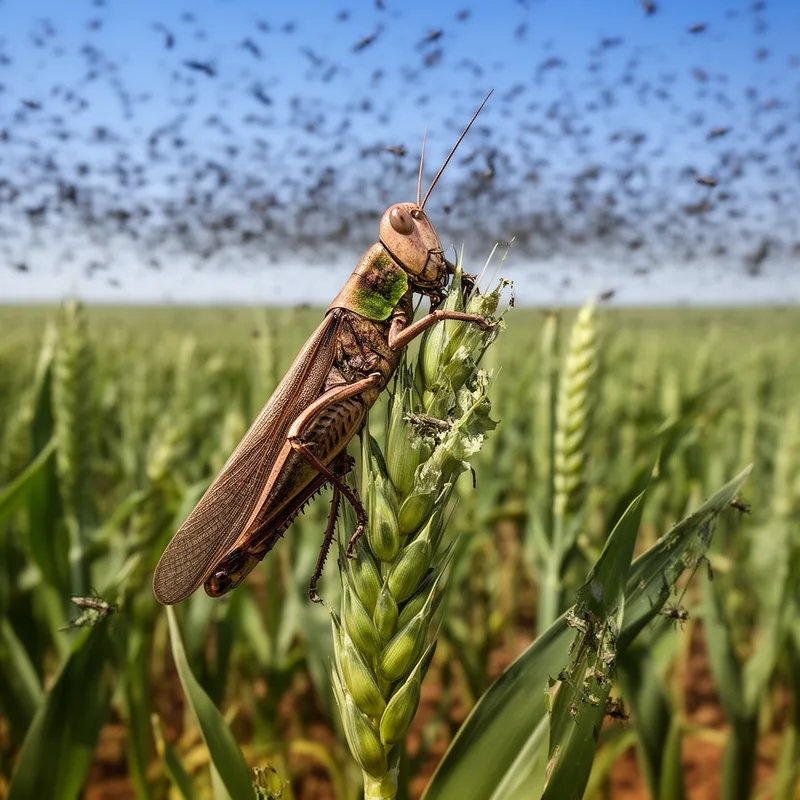
migratory locust
- noun
- /ˈmaɪɡrəˌtɔri ˈloʊkəst/
- UK
- Scientists are studying the swarming behavior of the migratory locust to better predict outbreaks.
Examples
-
The sudden invasion of migratory locusts caused severe food shortages in the affected villages.
-
During drought years, the migratory locust destroyed crops across entire regions.
-
The migratory locust can devastate entire fields.
-
Farmers are worried about the migratory locusts invading their crops.
-
The sudden invasion of migratory locusts caused severe food shortages in the affected villages.
-
During drought years, the migratory locust destroyed crops across entire regions.
-
Farmers are worried about the migratory locusts invading their crops.
Synonyms

 32
4.1
32
4.1

A large grasshopper that forms huge swarms and eats crops

A large grasshopper that forms huge swarms and eats crops
Surface Forms
Morphology
The meaning is directly compositional: 'migratory' describes movement/migration and 'locust' is a grasshopper species, so a learner who knows both words can infer a locust that migrates or moves in swarms. The concept is literal and cross-linguistically common, following normal adjective + noun composition, so it should be immediately understandable to a B1 learner.
Etymology
Migratory locust is named for how the insect behaves: migratory means 'moving from place to place' and locust is a kind of grasshopper that gathers in huge swarms. So the name gives the image of insects that travel in large groups and eat crops, which is why it means 'an insect that moves in large swarms and destroys crops'.