
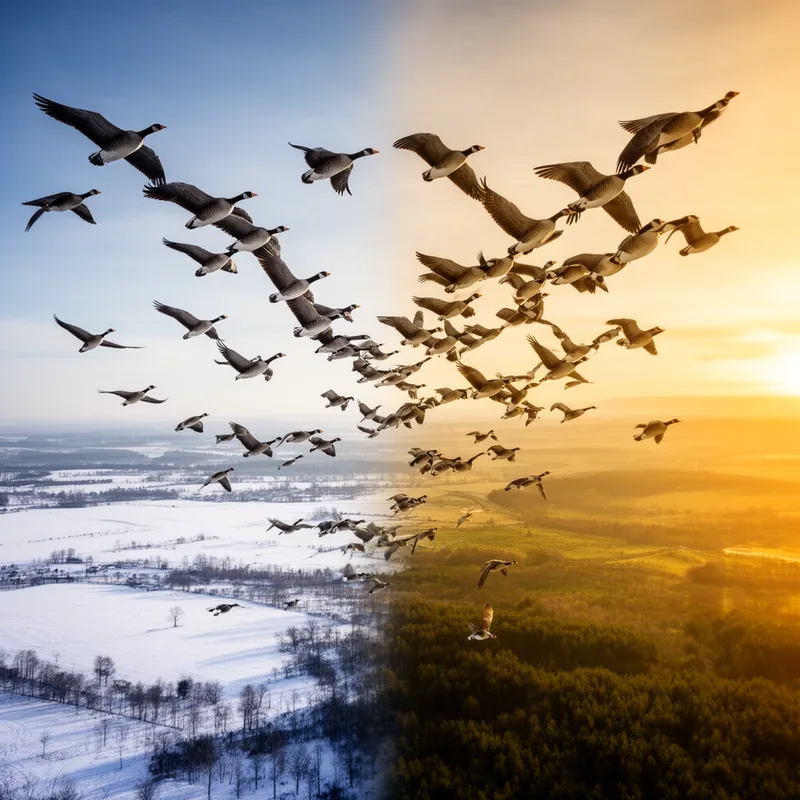
to migrate
 76
3.1
76
3.1

- verb
- /maɪˈɡreɪt/
- After the war, many people chose to migrate in search of a better life and new opportunities.
- people migrate
- animals migrate
- migrate to cities
Loading YouTube…
Watch on YouTubeHere's how snails end up migrating the entirely wrong way.
- Here's how snails end up migrating the entirely wrong way.
- My, my family's from Georgia and they all migrated, migrated across the border into Florida.
- And by, you know, by, by the fall, they're already starting to migrate southward.
- It's like we're wild animals, you know, migrating across the plains and that's huge.
- Now these fish migrate to this spot every single year to spawn or breed.
- Because palm C has to migrate into the new skin as it's growing.
- So so you refer to them as working class migrating.
Examples
-
One day she stood within an arm's length of a migrating herd of caribou.
Fiction book (2000) -
And my father, he migrated from Ireland when he was young, after the war.
-
These things migrate from Canada all the way down to Mexico.
-
So women, for example, migrate much less than men do.
-
Perhaps these were birds that had been unable to migrate due to injuries or some genetic absence.
Fiction book (1998) -
Now these fish migrate to this spot every single year to spawn or breed.
-
Humpback whales will migrate past this coastline every year during winter.
-
So you, like many other LGBT Africans, migrate to South Africa.
-
At least one-half of the needed educated workers migrated from other states and countries.
Academic text (2013) -
DNA analyses confirm that female bats migrate from Jalisco, Mexico, to Arizona, Sonora, and Baja California.
Academic text (1999)
Synonyms
 439
1.0
439
1.0
To enter and begin to be in a place, for example when people start living there and when weather arrives
 147
3.7
147
3.7
Move to a new place and start living or working there
 34
3.7
34
3.7
To leave your own country to live in another country permanently
 15
4.3
15
4.3
Move to a new place to live when something forces you to leave your home
 5
7.2
5
7.2
Leave home and move to a new place

To move to another country or region to live there
Antonyms

How Permanent

Surface Forms
Morphology
migrate = migr + ate
Formed from the Latin combining form 'migr-' plus the verb-forming suffix '-ate'; the root 'migr' is not a standalone English word, so learners cannot transparently derive 'move' from the parts.
Etymology
Migrate comes from the old Latin verb migrare, which means 'to move' or 'change place'. Think of birds flying to a warmer home or families moving to a new city, and that's why we use migrate for people or animals who move to live in another place.