
microtome


 1
9.9
- noun
- /ˈmaɪkrəˌtoʊm/
- Specialized
- Sections (1 um) were cut using a Leica Ultracut UCT microtome (Leica, Germany) and transferred onto glass slides.
Examples
-
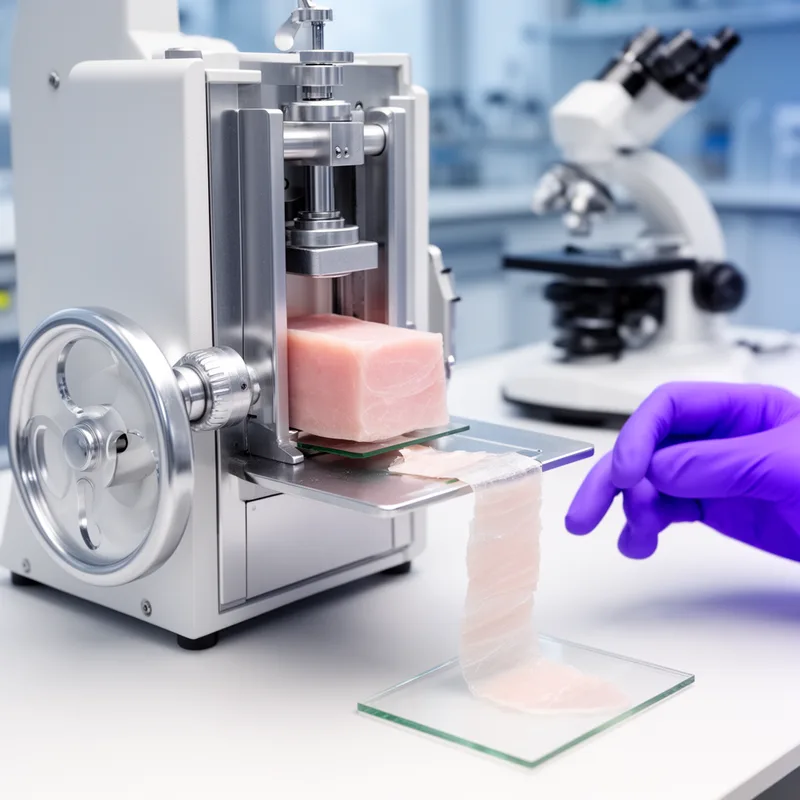
In the lab, a microtome is essential for slicing tissue samples thin enough for clear visibility during microscopy.
-
Cross sections of 5 micrometers of the tissue in blocks of paraffin were sliced with a microtome.
Academic text (2001) -
300 m thick slices were cut using a Campden Instruments 700 SMZ vibrating microtome.
Academic text (2017) -
The DRGs were cryoprotected by overnight incubation in 30% sucrose, sectioned at 40 µm on a freezing microtome.
Academic text (2016) -
The researcher used a microtome to create ultra-thin sections of the specimen for analysis under the microscope.
-
For her thesis, she prepared slides by cutting samples with a microtome, allowing for detailed microscopic examination.
Synonyms

A machine that cuts very thin slices of material for viewing under a microscope
How Thin

Surface Forms
Morphology
microtome = micro + tome
The word is built from the combining form micro- 'small' and the learned bound form -tome 'cutting instrument', so its scientific meaning is partly recoverable but not fully obvious to ordinary learners.
Etymology
Microtome comes from the Greek parts micro- meaning 'small' and -tome meaning 'to cut' or 'a slice', the same root you see in anatomy and atom. So a microtome is a tool that 'cuts small' very thin slices for looking under a microscope.