
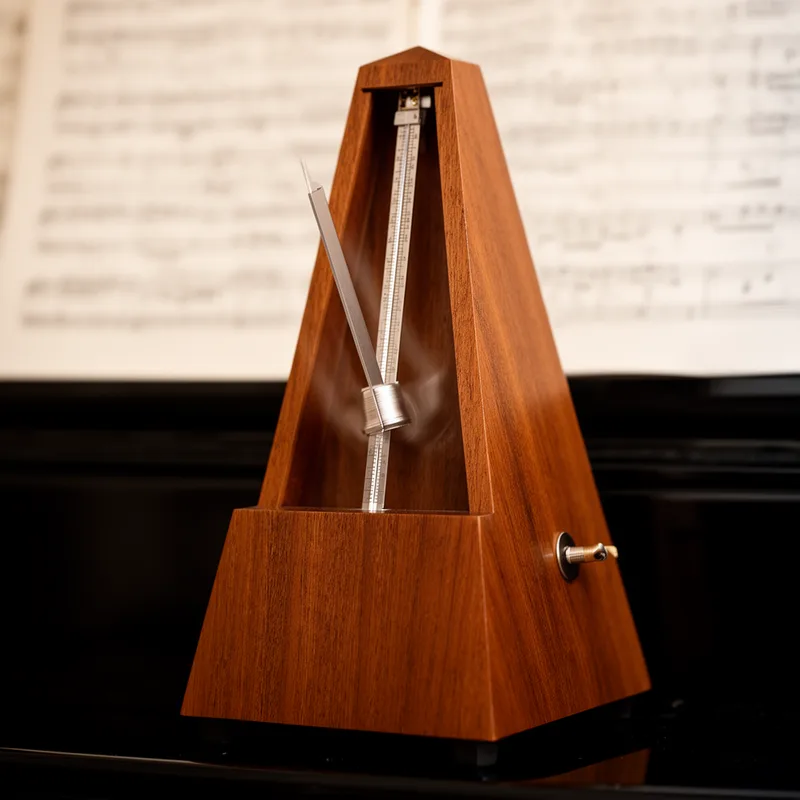
metronome
 10
4.9
10
4.9

- noun
- /ˈmɛtrəˌnoʊm/
- A metronome provides a steady click sound to help musicians keep time.
- metronome beat
- metronome tempo
- set a metronome
Loading YouTube…
Watch on YouTubeConduct, conduct, turn the metronome on.
- Conduct, conduct, turn the metronome on.
- Then he would just say, so it was like, you have like they that he would set a metronome.
Examples
-
Find this tempo on your metronome and write the number on your music.
Academic text (2004) -
Just listen to the ticking of the metronome.
-
I work with a metronome a lot, you know, and, and it's good for me.
-
A little electronic metronome sets the time.
-
Instead, the teacher assigned goals with specific metronome markings for the students to practice.
Academic text (2014) -
Select a comfortable tempo for the music and set your metronome to it.
Academic text (1996) -
The metronome continued until the participant played the first note of the sequence, after which the metronome stopped.
Academic text (2011) -
Teachers can accompany their students with a pulse, or a metronome can serve as an accompaniment.
Academic text (1998) -
Once the proctor turned the metronome off, participants performed the music one last time, which served as the posttest.
Academic text (2013) -
The metronome feedback can assist students in synchronizing their steady beat movement with the metronome's steady beat vibration.
Academic text (2015)
Compounds
- Specialized
The number of beats per minute that tells how fast the music should be played
Surface Forms
Morphology
metronome = metron + nome
Although the word is a learned formation from Greek combining forms meaning 'measure' + 'rule/management', those components are not productive or recognizable to an average B1 learner, so the meaning 'tempo device' cannot be reliably derived from its parts.
Etymology
The word metronome comes from the Greek parts metron ('measure') and nomos ('rule'), and you can see metron in the word meter. So a metronome is a small device that 'measures' time and makes steady ticks to show the speed of the music.