
metallicity
 1
9.9
1
9.9

- noun
- /ˌmɛtəˈlɪsɪti/
- Specialized
- If you start with an initial mass function and a star formation rate, you can derive the number of stars with a particular metallicity for a particular epoch in a galaxy.
- metallicity of a star
Examples
-
Furthermore, there is no correlation with metallicity.
Academic text (2005) -
I think Chronos made a good point about requiring an abundance of metallicity.
Blog text (16) -
So how bright you think a star of a certain age and mass and metallicity could be, that will vary.
-
Then we've got to take into account the problem of largely past flare activity, tidal locking, lesser metallicity, and a number of other such things...
Blog text (1) -
Based on the observed stellar metallicity, it is apparent that s-process elements did not make significant contributions to the interstellar medium until the galaxy was about a billion years old.
Academic text (2005) -
Given that life as we can imagine it demands an abundance of metallicity, it appears unlikely it could have originated less than 5 billion years after the big bang—or between 8 and 9 billion years ago.
Blog text (16) -
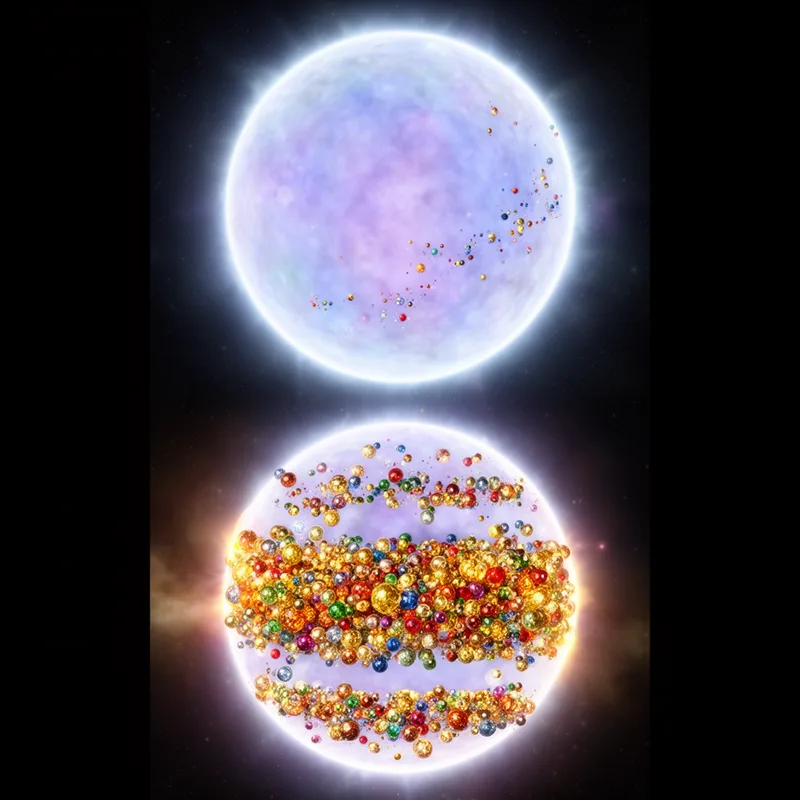
(Actually, astronomers consider elements heavier than helium to be "metals" -- the metallicity of a star is indicated by the abundance ratio of iron to hydrogen.)
Academic text (2005) -
Could some of the so-called first-string, second-generation stars have modified metallicities from nebula passage doping?
Blog text (16) -
The metallicity of a star (its richness in elements heavier than hydrogen and helium) would clearly exert a subtle but critical effect on the biochemistry of dependent worlds.
Academic text (1999) -
Astronomers can determine a star's metallicity by analyzing its chemical composition.
Surface Forms
Morphology
Etymology
Metallicity comes from metal 'metal' and the ending -ity 'state or quality'. In astronomy, people call any element heavier than hydrogen or helium a 'metal', so a star's metallicity tells you how much of those heavier elements it has.