
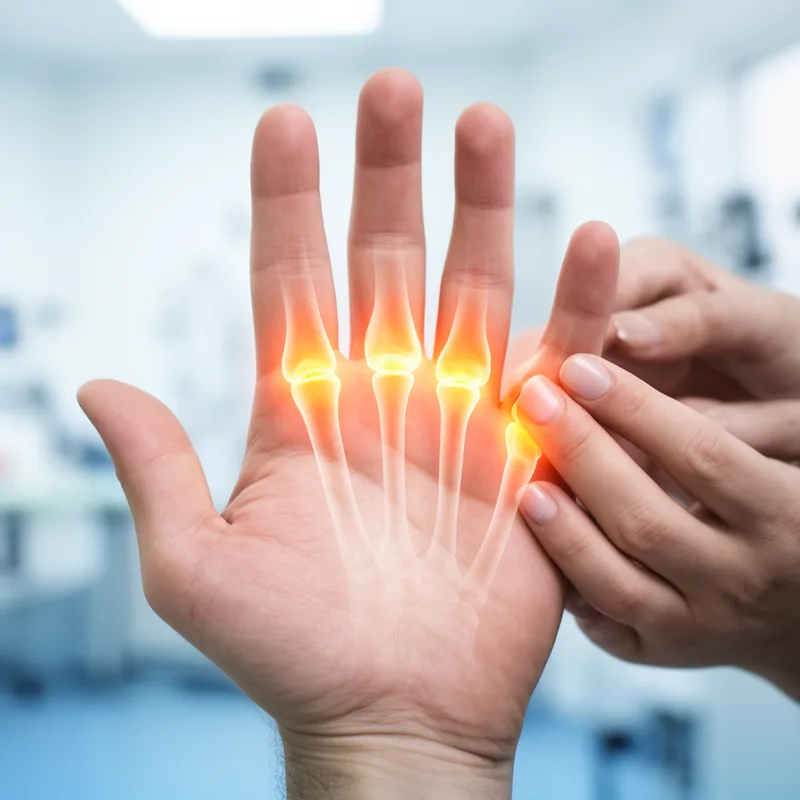
metacarpophalangeal
- adjective
- /ˌmɛtəˌkɑrpoʊfəˈleɪndʒiəl/
- Specialized
- During the physical therapy session, she focused on improving the flexibility of her metacarpophalangeal joints.
- metacarpophalangeal joint
Examples
-
Hands, wrists, elbows, shoulders, knees, and ankles are commonly affected symmetrically, and sufferers present with pain in the metacarpophalangeal joints of the hands or metatarsophalangeal joints of the feet.
Academic text (2015) -
The doctor examined the patient's metacarpophalangeal joints for signs of inflammation.
-
There were no significant differences between the operated and nonoperated hands at a mean follow-up of 86 months, except for significantly reduced flexion in the metacarpophalangeal joint.
Academic text (2011) -
Criteria included the ability to extend at least 10 degrees at the metacarpophalangeal and interphalangeal joints and 20 degrees at the wrist (the focal criterion).
Academic text (2001) -
Understanding the structure of the metacarpophalangeal joints can help in diagnosing hand injuries.
Compounds


Surface Forms
Morphology
metacarpophalangeal = metacarpal + phalangeal (semi-transparent) = metacarpal + phalangeal
The adjective is a straightforward combination of technical anatomical terms ('metacarpal' + 'phalangeal'), but both components are specialized terms likely unfamiliar to an average B1 learner.
Etymology
The word metacarpophalangeal breaks into three parts: meta- meaning 'after' or 'beyond', carpo- meaning 'wrist', and phalanx meaning 'finger bone'. So metacarpophalangeal refers to the knuckle joints 'beyond the wrist' where the hand bones meet the finger bones, which is why it names those finger joints.