

memory trace
- noun
- Specialized
- Memory traces in the nervous system are widely believed to be stored as relative strengths of synaptic connections (Martin et al., 2000).
Examples
-
A suboptimal working memory system will result in poorer integrity of memory traces involved in word learning and can thus impede the development of vocabulary and literacy (see Gathercole & Baddeley, 1993).
Academic text (2012) -
This process may make the memory traces of unknown items more distinct (i.e., discriminable from the myriad other traces in LTM) and increase the likelihood that they will be successfully retrieved during testing.
Academic text (2014) -
How these memory traces change as we age?
-
All memory traces have been completely erased.
-
The memory trace becomes dormant; however, upon adequate stimulation, these traces are still retrievable.
Academic text (2000) -
These include difficulties with computing spatial information from incoming sensory cues, deficits with forming stable and distinct memory traces of spatial information, and challenges arising during planning and control of navigational behavior.
Academic text (2017) -
Researchers are studying how memory traces form in the brain after learning new information.
-
When memories fade, the traces left behind in our brain may still influence our thoughts.
-
Experiments show that different experiences create distinct memory traces within the neural network.
Synonyms
 6
9.9
6
9.9

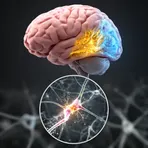
A change in the brain that stores a memory
Surface Forms
Morphology
The meaning 'a recorded sequence or log of memory-related events' is directly and compositionally derived from 'memory' (information storage) + 'trace' (a record or log). Although the usage is technical, the noun-noun combination follows a transparent 'trace of X' pattern that a B1 learner who knows both constituents can reasonably infer.
Etymology
The noun memory trace comes from the idea of a small trace or mark left in memory, like a footprint in the sand that shows someone passed by. So it means 'a small physical change in the brain that stores a memory'.