

memento mori
 1
9.9
1
9.9

- noun
- /məˈmɛnˌtoʊ ˈmɔːri/
- Literature
- The surviving cactus functions as a kind of memento mori of potential peril.
Loading YouTube…
Watch on YouTubeAnd at the end of it, I end with memento Mori, the Latin for Remember you will die.
- And at the end of it, I end with memento Mori, the Latin for Remember you will die.
- But yes, the point of memento Mori at bedtime is to go Where are you rushing towards again?
- It's something that the Stoics did memento Mori to meditate on death.
Examples
-
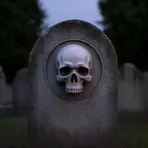
A skull is often used as a memento mori to remind us of our mortality.
-
It's a memento mori clock.
-
And at the end of it, I end with memento Mori, the Latin for Remember you will die.
-
We might read Moulsworth's poem as a meditation on Christian death, as a form of memento mori.
Fiction book (1996) -
Anasazi ruins, to some Navajos, are a memento mori or a warning.
Academic text (1993) -
There is an illusion here, an illusion that can be dispelled only by a memento mori, a reminder of my mortality, a "remember to die," as if I might forget and go on living forever.
Academic text (1990) -
The store and its weedy parking lot, enclosed by a chain-link fence, were a retail memento mori, a suggestion that progress was not the only force in the city.
Academic text (2004) -
In the art gallery, the artist displayed a piece that served as a memento mori, symbolizing the fleeting nature of life.
-
The old tombstone acted as a memento mori, urging visitors to reflect on the inevitability of death.
Synonyms

 1
9.1
1
9.1
An image or object of a human skull used as a symbol of death
How Morbid

Surface Forms
Morphology
memento + mori
The phrase is compositionally built from 'memento' (reminder) + Latin 'mori' (to die), so if a learner knew both elements the meaning 'reminder of death' is derivable. However, 'mori' is a non-English (Latin) element and is not listed in the provided dictionary entry, and the expression functions as a fixed Latin loan; this makes it partially opaque to a typical B1 learner who will not know the Latin morpheme.
Etymology
Memento mori comes from Latin words memento and mori, which mean 'remember' and 'to die'. In old times people placed objects like skulls, clocks, or paintings where they could see them as a memento mori to remind themselves that life ends. That's why today the phrase means 'a reminder that death will come'.