
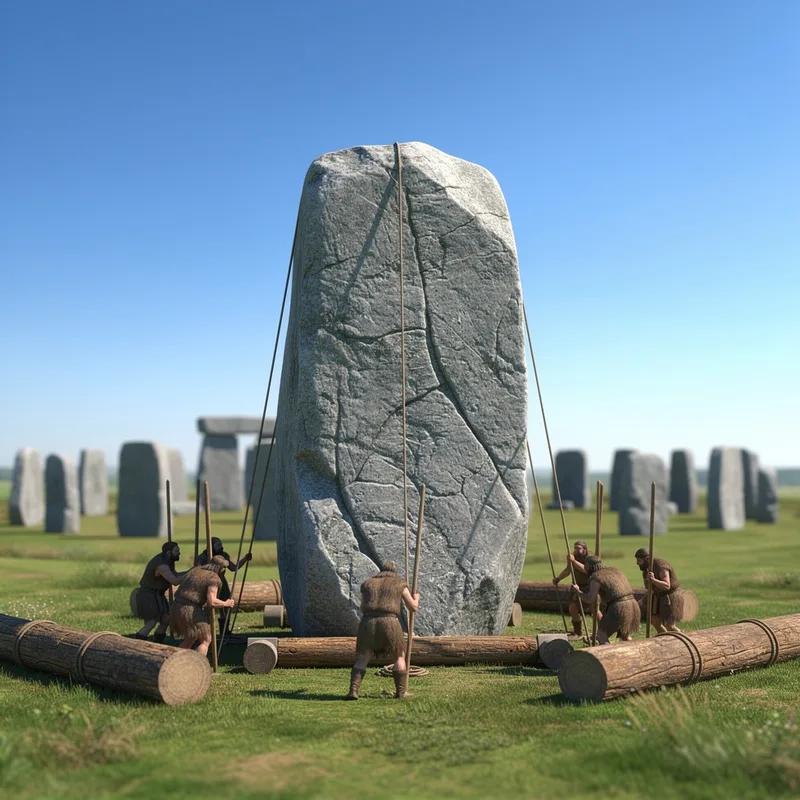
megalith
 3
9.5
3
9.5

- noun
- /ˈmɛɡəˌlɪθ/
- The great Neolithic monument of Stonehenge, arguably Britain's most famous megalith, is finally being ensured for future generations.
- carving megaliths
- large megalith
Loading YouTube…
Watch on YouTubeIncluding Bronze Age Kirigsur burial mounds, deer stone megaliths, ancient city fortifications.
- Including Bronze Age Kirigsur burial mounds, deer stone megaliths, ancient city fortifications.
- I would think the best sculptors and mover of megaliths in the entire the Aztecs.
- Like meanwhile, right next to Ebola in Lebanon, we find the emergence of gigantic megaliths that look like Ebola but bigger.
Examples
-
Luckily, most of the megaliths were undamaged and have been returned to their original position.
Academic text (2004) -
The megaliths, which may have once supported roofs, are about nine feet tall.
Academic text (2008) -
Ritual megaliths and posts are still erected on the large island off the east coast of Africa.
Academic text (2008) -
The megalith, as large as any at Stonehenge, is not in danger of tipping over.
Academic text (2003) -
Belle-le had its share of antique megaliths as well.
Academic text (2015) -
The project documented 88 sites, including 42 megaliths of varying types.
Academic text (2007) -
Six hundred years later, the stone megaliths look down on the tiled roofs of Cuzco.
Fiction book (1991) -
Now we understand the megaliths are roughly the same age as the ceremonial timber rings at Durrington Walls and Woodhenge.
Academic text (2008) -
More than 4,000 years ago, Stonehenge was a monumental construction site, as megaliths and posts were shaped, positioned, and rearranged.
Academic text (2008) -
More than 4,000 years ago, Stonehenge was built using large megaliths that still stand today.
Synonyms
 9
7.5
9
7.5
A large single upright block of stone that forms a pillar or monument
 1
9.2
1
9.2
A monument of very large stones that dates from long ago
How Big

Surface Forms
Morphology
megalith = mega + lith
The word is built from the classical elements mega- 'large' and lith- 'stone', but the second element is not a common standalone English word, so most B1 learners would not infer the meaning from the parts.
Etymology
Megalith comes from two Greek parts: mega- meaning 'large' and -lith meaning 'stone', the same lith you see in monolith. So a megalith is a 'large stone', which is why we use it for the very big stones in ancient monuments.