
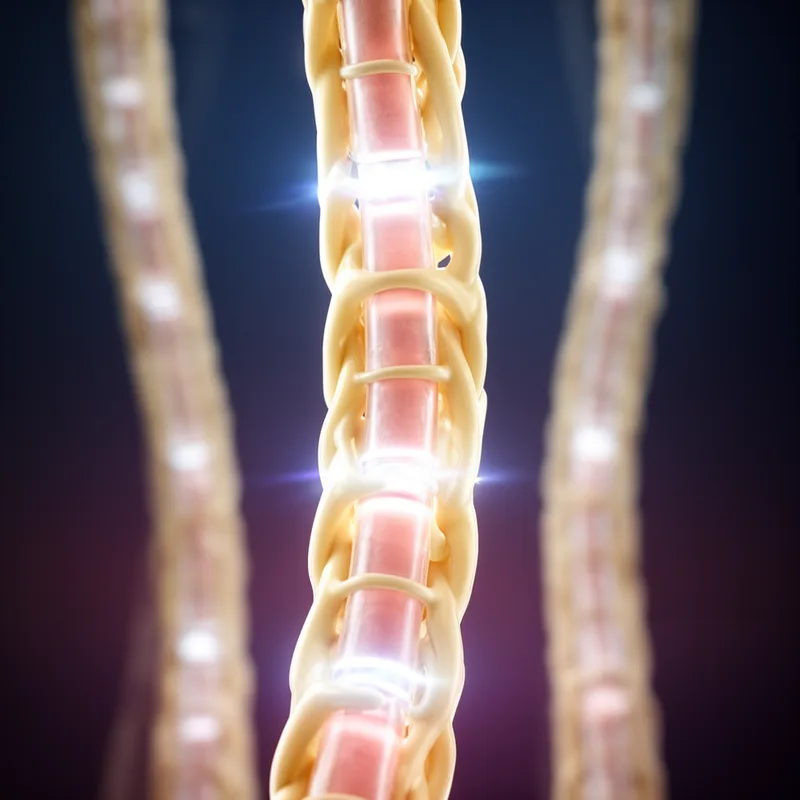
medullary sheath
- noun
- /ˈmɛdʌləri ʃiːθ/
- Specialized
- Damage to the medullary sheath can result in neurological disorders such as multiple sclerosis.
Examples
-
The medullary sheath plays a crucial role in speeding up nerve impulse conduction.
-
During development, the medullary sheath gradually forms around the axons in the central nervous system.
-
The medullary sheath protects nerve fibers.
-
In some neurons, the medullary sheath is crucial for speed.
-
Damage to the medullary sheath can result in neurological disorders such as multiple sclerosis.
-
During development, the medullary sheath gradually forms around the axons in the central nervous system.
-
The medullary sheath plays a crucial role in speeding up nerve impulse conduction.
Synonyms

 7
8.6
7
8.6

A white fatty layer around nerve fibers that helps signals travel quickly
 1
7.2
1
7.2
A fatty layer around nerve fibers that helps signals travel fast
A thin membrane that surrounds a nerve fiber and helps it heal
A thin outer covering around nerves outside the brain and spinal cord that helps them heal
Surface Forms
Morphology
The phrase is compositional: 'medullary' means relating to medulla/marrow or central tissue and 'sheath' means a covering, so a learner who knows both constituents can infer a covering associated with medullary tissue. This is a literal, technical noun phrase rather than an idiom or metaphorical usage, so its meaning is transparently derivable from the parts.
Etymology
The term medullary sheath gives the image of a thin sheath, or sleeve, wrapped around the nerve's inner part, the medullary area. That sleeve 'protects' the nerve and helps signals 'speed up', so the name explains its job.