
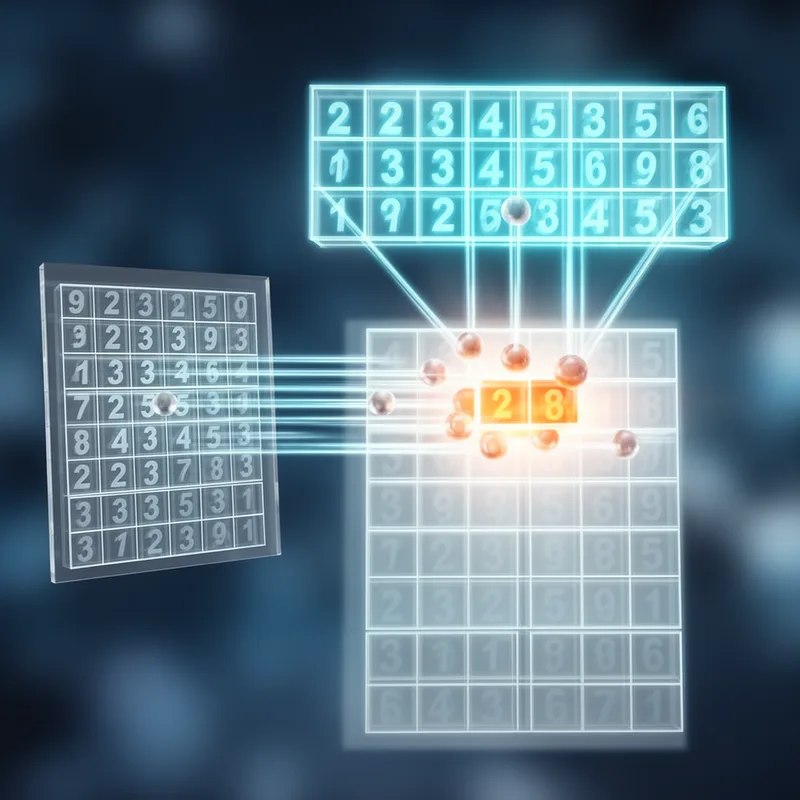
matrix multiplication


 1
6.3
1
6.3
- noun
- /ˈmeɪtrɪks ˌmʌltɪplɪˈkeɪʃən/
- Specialized
- Computer graphics often rely on matrix multiplication to manipulate the positions of objects on the screen.
Loading YouTube…
Watch on YouTubeThat's what the notation of matrix multiplication produces.
- That's what the notation of matrix multiplication produces.
Examples
-
Now the researchers have found a way to simplify photonic matrix multiplication so that it works more efficiently for real numbers.
-
To rotate an image, you can perform matrix multiplication with the appropriate transformation matrix.
-
That's the way matrix multiplication works, by columns.
-
Order matters, so we know that matrix multiplication isn't commutative.
-
In addition, conversion between any two color spaces corresponding to different bases for the three-dimensional subspace of spectral power distributions defined by the human viewer may be accomplished by a simple 3 x 3 matrix multiplication.
Academic text (1992) -
In linear algebra, matrix multiplication allows us to combine two matrices to create a new one.
Surface Forms
Morphology
The phrase is fully compositional: 'matrix' (a rectangular array of numbers) combined with 'multiplication' (the mathematical operation) directly yields the idea of multiplying matrices. While the specific procedural rules are technical, the general meaning — performing the multiplication operation on matrices to produce another matrix — is transparently deducible by a learner who knows both constituent words.
Etymology
Matrix multiplication comes from the idea of multiplying two grids of numbers called a matrix. Imagine taking one row from the first grid and one column from the second, multiplying the matching numbers and adding them to make one number. That's why the name links 'multiplication' to making a new grid of numbers from two matrices.