
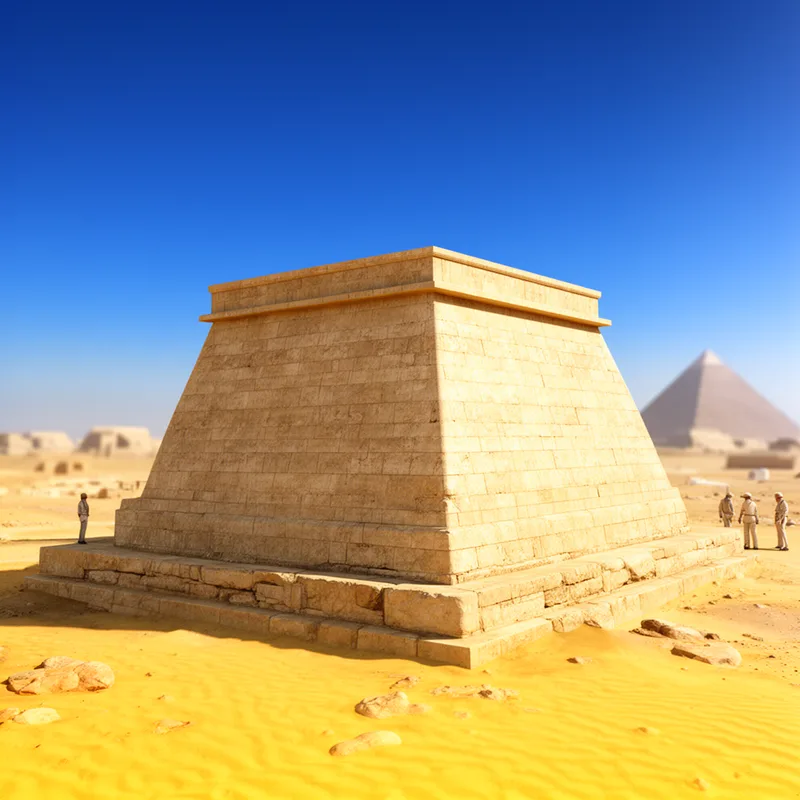
mastaba


 1
9.9
- noun
- /mɑːˈstæbə/
- Specialized
- With a large workforce and a rail system to carry away the overburden, "Papa George," as he was known, moved more than 11,000 cartloads of sand and excavated twenty-two mastaba tombs, low rectangular brick or stone structures.
- mastaba tomb
Examples
-
On the walls of the queen's burial mastaba, he wrote a poem to her, which is spectacular... - Oh, sir, may I see? - Oh, yes.
-
And then they start building what's called mastabas, which is like a, it's like a giant stone Twinkie basically.
-
But these mastabas, they would go, OK, they built this huge stone structure so that we can't reach the hole that goes into the ground.
-
Thus, none but the priests of Karnak know Kharis' mastaba.
-
Called mastabas (Arabic for "bench"), each of these buildings consists of a central room for funerary objects, a burial chamber, and additional rooms.
Academic text (2006) -
Muntazir Rahmat Allah sits in an armchair to the left of this rock while five of his neighbors sit willfully and vexedly on the right side of it on a mastaba, a wooden bench.
Academic text (1997) -
The ancient Egyptians built a mastaba as a tomb for their pharaohs, featuring a rectangular base and a flat roof.
-
Archaeologists discovered several mastabas near the pyramids, each designed with sloping sides made of mud-brick.
-
In ancient Egypt, a mastaba served as a tomb, characterized by its low, rectangular structure with a flat top.
Synonyms
 227
3.0
A large stone building or underground room where people put a dead person
An ancient Egyptian tomb with a rectangular base, sloping sides and a flat roof often made of mud bricks
How Big

Surface Forms
Etymology
The word mastaba comes from the Arabic mastaba, meaning 'bench'. These early Egyptian tombs looked like low, flat benches, so mastaba now means a rectangular mud-brick tomb with sloping sides and a flat roof.