
marsileaceous
- adjective
- /mɑrˌsɪˈliːʃəs/
- Specialized
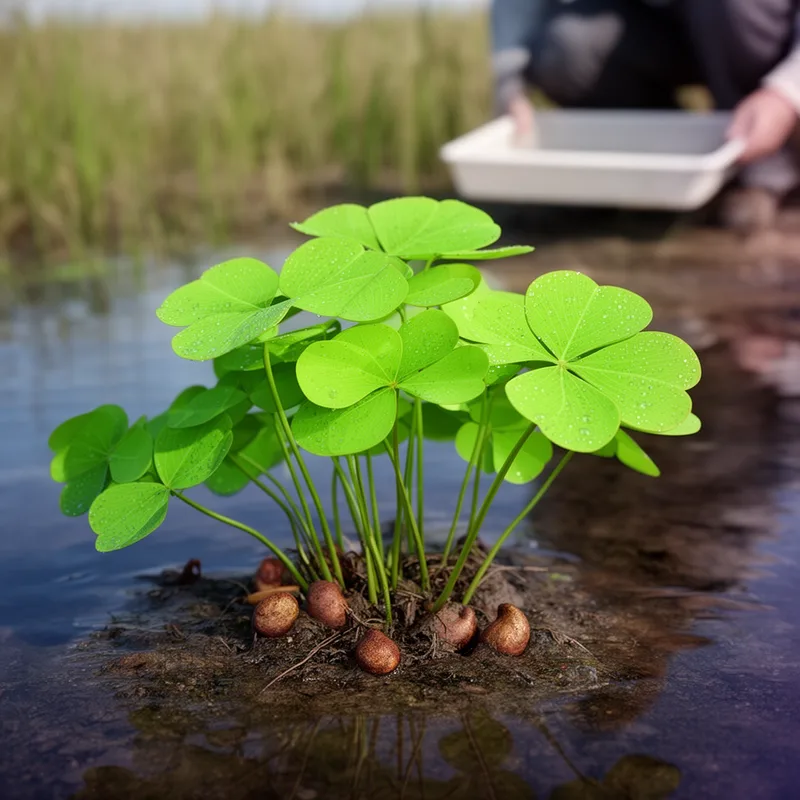
- Marsileaceous ferns occupy unstable, ephemeral habitats, such as the edges of ponds.
- marsileaceous ferns
Examples
-
Pryer notes that organisms that thrive in uncertain habitats are generally small and mature rapidly—just like the marsileaceous ferns.
Academic text (1996) -
The marsileaceous leaf shapes were apparently derived from an ancestral leaf shape that was more divided and complex than that of Marsilea.
Academic text (1996) -
PHOTOS (BLACK & WHITE): As the marsileaceous ferns evolved, the time to maturity was reduced relative to leaf development.
Academic text (1996) -
To create a family tree for the marsileaceous ferns, Pryer analyzed both morphological characteristics and sequence data for a Rubisco gene.
Academic text (1996) -
Hints of heterochronic changes during the evolution of the marsileaceous ferns come from patterns of leaf development in the three genera that make up the family.
Academic text (1996) -
Marsileaceous ferns are often found at the edges of ponds, showcasing their unique adaptation to aquatic environments.
-
The characteristics of marsileaceous plants make them particularly resilient to changes in their wetland habitats.
-
Many scientists study marsileaceous ferns to understand how they survived in fluctuating water levels.
Surface Forms
Morphology
marsileaceous = Marsilea (semi-transparent) = marsile + aceous
The adjective is a regular botanical formation from the genus name Marsilea plus -aceous, but the resulting taxonomic meaning is specialized rather than fully obvious to non-specialists.
Etymology
Marsileaceous comes from the plant name Marsilea and the ending -aceous, which means 'like' or 'related to'. So, it literally means 'like the ferns of Marsilea' and helps you remember it refers to aquatic ferns that grow in ponds and wet places.

