
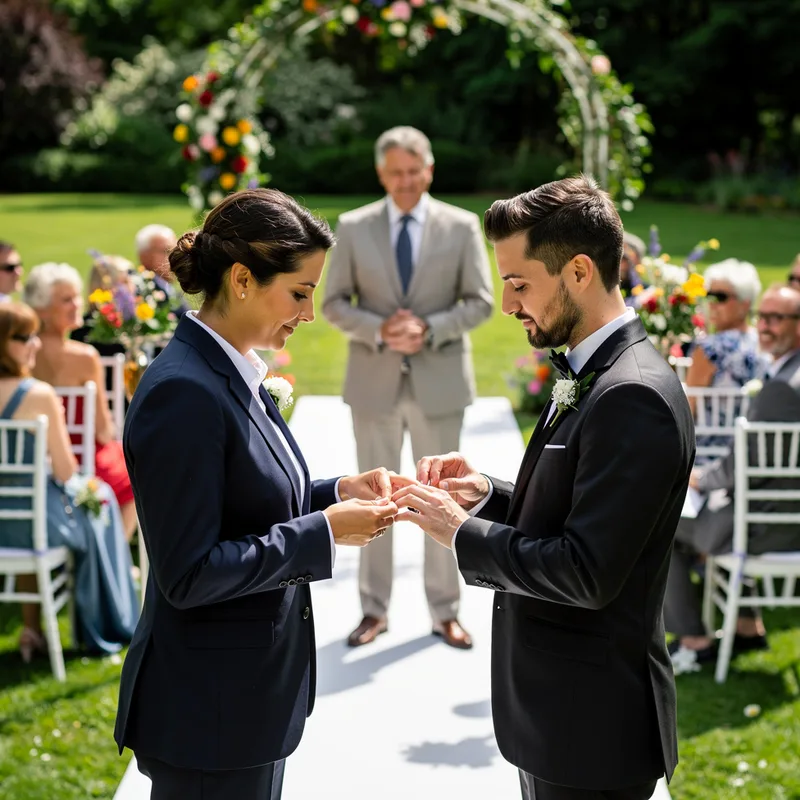
marriage ceremony
 6
2.3
6
2.3

- noun
- /ˈmɛrɪdʒ ˈsɛrəˌmoʊni/
- During the marriage ceremony, the couple exchanged vows and rings to symbolize their commitment.
- marriage ceremony in Igbo culture
- the marriage ceremony day
Examples
-
In fact, after the marriage ceremony takes place, Julien's family life begins to resemble the life he abandoned.
Academic text (2003) -
People believed that engaged couples had ample time to get to know one another after the marriage ceremony.
Fiction book (1997) -
There will be a marriage ceremony later in the day.
-
Only your permission is left, and we shall have a marriage ceremony.
Fiction book (1992) -
My mother's mother was a picture bride who met her husband a few hours before the marriage ceremony.
Fiction book (2000) -
Any marriage ceremony without the consent and assistance of kinfolk is impossible.
Academic text (2001) -
There is nothing incongruous, for instance, with there being three separate marriage ceremonies: customary, civil, and church.
Academic text (1993) -
I'm a mail-order minister, ordained in the Church of Celestial Power and Light, Incorporated, capable of performing legally binding marriage ceremonies anywhere.
-
The couple planned a beautiful marriage ceremony in a garden surrounded by family and friends.
-
Guests arrived early to witness the marriage ceremony that would unite the two families.
Synonyms
 ∞
1.0
∞
1.0
A ceremony and celebration where two people get married
 901
2.5
901
2.5
A formal event that follows traditional rules for a special occasion
 24
5.3
24
5.3
A formal ceremony when two people become married
 14
1.1
14
1.1
A formal event where two people promise to marry and exchange vows
 5
3.2
5
3.2
A marriage ceremony carried out by a government official rather than a religious leader
A wedding ceremony where people celebrate a marriage

A formal public ceremony that makes a marriage or other rite official

A traditional ceremony where two people join hands to promise to marry each other

An old ceremony where two people promise to marry by joining hands

An engagement or a wedding ceremony
How Formal

Surface Forms
Morphology
The meaning is directly and transparently derived from combining 'marriage' (a legally recognized partnership) with 'ceremony' (a formal event); together they straightforwardly denote the formal event uniting two people. This is a common, compositional noun+noun combination found across many languages, so a B1 learner who knows both constituents will readily understand it.
Etymology
Marriage ceremony comes from the idea of a public event where two people promise to live together as partners. The word marriage names the joining and ceremony names the formal actions people watch, and imagining vows and rings in front of family shows why the phrase means the formal event that 'unites' two people.