
manometry
- noun
- /məˈnämətrē/
- Specialized
 :
manometría
:
manometría
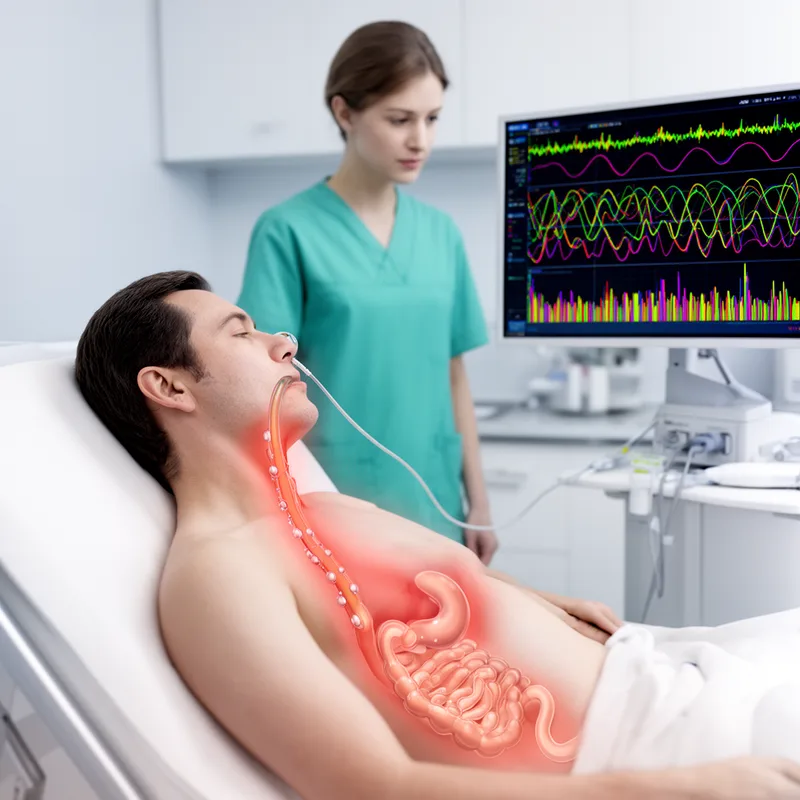
- Finally, manometry is used to evaluate esophageal body motor function.
- anorectal manometry
- esophageal manometry
Examples
-
Manometry not only accurately locates the UES and LES, but it also allows for evaluation of pharyngoesophageal function.
Academic text (2002) -
During the first anorectal manometry, the child and parent could watch the tracing on the computer screen.
Academic text (2000) -
Should manometry be performed first in order to ascertain sphincter location?
Academic text (2002) -
Anal manometry was repeated at the previously indicated intervals in all patients.
Academic text (1992) -
Anorectal manometry was usually done without bowel preparation.
Academic text (2000) -
Esophageal manometry is the preferred method of guiding pH probe placement.
Academic text (2002) -
We opted to compare manometric values of all patients; therefore, patients in the CT group also received anorectal manometry at the start and the end of the intervention period.
Academic text (2000) -
Patients had a medical history, abdominal and rectal examination, and anorectal manometry at the start and end of the 6-week intervention period.
Academic text (2000) -
Anorectal manometry in constipated patients has shown impaired rectal sensation, inability to defecate balloons, and abnormal defecation dynamics.
Academic text (2000) -
During the procedure, the doctor used manometry to measure the pressure inside the patient's esophagus.
How Specific


Surface Forms
Morphology
manometry = manometer (semi-transparent) = mano + metry
The word is related to 'manometer' (instrument), but the instrument-vs-measurement relation is technical and not fully obvious to learners.
Etymology
Manometry breaks into mano- and -metry. The -metry part means 'measure', as in thermometer, and mano- comes from a Greek word meaning 'thin', so manometry is the measurement of pressure, that is, how 'thin' or 'thick' a liquid or gas is inside the body.