

mannerist
- adjective
- /ˈmænərɪst/
- Trained at Bryn Mawr in Northern (Dutch) Mannerist painting, she then taught at Bowdoin, later working in New Orleans in a nonprofit organization with public school teachers in the Delta River Region, and teaching a course at Tulane University.
- mannerist style
Examples
-
Mannerist artists had long been toying with the illusion of continuity between spectator and painted scene, but in general these were tours de force that called attention to themselves as illusions, rather than to the subjects and their meaning.
Academic text (2007) -
Could a viewer in what we now call the Mannerist period have considered it without being diverted by issues of its artistry?
Academic text (1999) -
Chassriau's attenuation of his figures certainly borrows a Mannerist aesthetic.
Academic text (2004) -
Some of the ways in which she tells that story involve repetitive rhetorical phrases that feel quite mannerist and yet they're super moving.
-
Stolbach perceived this godly gesture not as overemphatic, forced, cramped, heavy-handed, or proto-Mannerist, but as Christian.
Academic text (1992) -
What's more, the artifice that Mannerist animators carried out with clay and colors could seem uncomfortably close to the operations that the Satanic trickster performed with living victims, using air to cloud those victims' perception and change their visible behavior.
Academic text (2002) -
Caravaggio adapts Mannerist tradition only to the extent that he again seems to penetrate the picture plane, not as an exhibitionist but as a dramatist who seizes our attention in order to illuminate the meaning of the story within the frame.
Academic text (2007) -
The painting is often criticized for its mannerist style, which emphasizes artificiality over realism.
-
Her mannerist gestures during the presentation made it difficult for the audience to take her seriously.
-
Critics described the film's dialogue as mannerist, filled with exaggerated expressions that distracted from the plot.
Synonyms

 47
7.9
47
7.9

Actions like speech or writing that do not seem natural
 35
6.5
35
6.5
Being very bright and showy to attract attention
 32
5.6
32
5.6
Showing feelings in a way that is too strong
 10
4.9
10
4.9
Acting or speaking in a forced way to impress others
 8
3.2
8
3.2
Bright or fancy in a way that draws attention
 7
4.9
7
4.9
Showing too much feeling about small things
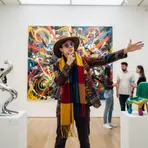 5
9.9
5
9.9
Trying to seem artistic in a showy, overdone way
 4
7.5
4
7.5
Trying to look like an artist but seeming fake or forced
 1
8.1
1
8.1
Being too dramatic and not natural, like acting on a stage


 1
8.8
1
8.8
Acting to get a lot of attention by showing off in public

Showing an unnatural, forced way of behaving
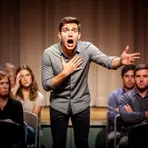
Showing loud, dramatic behaviour that seems fake

About public speaking that is very formal and showy
Antonyms


How Affected

Surface Forms
Morphology
Etymology
Mannerist comes from manner ('way' or 'style') and the ending -ist that marks a type, and it goes back to Italian maniera ('style'). So, because it first described a showy, artificial way of doing things, mannerist now describes something with an affected, exaggerated style.