

mango tree
 4
1.5
4
1.5

- noun
- /ˈmæŋɡoʊ tri/
- My mom misses her mango tree, but other than that they are super happy.
- shade of a mango tree
- grove of mango trees
- mango tree dropping fruit
Loading YouTube…
Watch on YouTubeAnd they'd all have lovely things, mango trees and all that.
- And they'd all have lovely things, mango trees and all that.
Examples
-
As long as anybody could remember, that same estate was only bush with one or two mango trees and coconuts growing on it.
Fiction book (2002) -
Sitting on steps in the shade of mango trees playing cards.
Fiction book (1997) -
If I know my horticulture, and I do, this is a grove of mango trees.
-
A mango tree in full bloom, its fruits hanging almost vertically, appears behind the cross.
Academic text (2014) -
He sat at the far end of the schoolyard, protected by the shade of a generous mango tree.
Fiction book (1999) -
Before reaching the steepest slope, we passed through a dense grove of mango trees, obviously cultivated by someone.
Academic text (1990) -
Breadfruit and coconut groves grew all around my village, and I resided in a thatched-roof house with no walls beneath a giant mango tree.
Academic text (2003) -
In the backyard, the children enjoyed climbing high into the branches of the mango tree to pick ripe fruit.
-
Under the shade of the mango tree, we enjoyed a picnic while savoring the sweet fruit.
-
During the summer, the fragrant blossoms of the mango tree attracted many butterflies to the garden.
Synonyms
 13
1.0
13
1.0
A tree that grows fruit you can eat
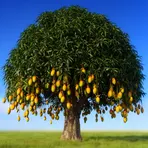 7
1.0
7
1.0
A large evergreen tree that produces oval tropical fruit
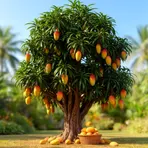
A large tree with leaves all year that grows sweet mango fruit
How Big

Surface Forms
Morphology
The meaning 'a tree that produces mangoes' is directly and transparently derived from combining 'mango' (the fruit/tree) with 'tree' (a perennial plant). This simple noun–noun composition is a basic, cross-linguistically common pattern, so a B1 learner who knows both constituents will readily understand the MWE.
Etymology
The name mango tree comes from a simple image: a tree that produces mango fruit. People in South Asia have planted these trees for their sweet fruit for a very long time, so the phrase means 'a large tropical tree that produces sweet mangoes'.