

mandrel
- noun
- /ˈmændrəl/
- Specialized
- They see the number of plies needed for the part and then determine exactly how each ply must be laid on the mandrel, the tool on which the plies are layered before they're sent to the autoclave.
Loading YouTube…
Watch on YouTubeSo now how do you get, how do you get it off of the, the mandrel?
- So now how do you get, how do you get it off of the, the mandrel?
Examples
-
To ensure accuracy, the machinist rotated the mandrel slowly while monitoring the cutting tool.
-
The rough bore formed when the mandrel was removed served as a pilot for drilling.
Academic text (2007) -
Substitute the mandrel's magnitude and you get that.
-
The fiberglass tool was about the same size and shape as the mandrel on which operators lay the plies.
Academic text (2005) -
The company's laser, fed by information from the planning software, casts a ply outline to the mandrel.
Academic text (2005) -
"The operator would heave it up on the mandrel, mark the ply location, take it back off, lay out the ply, then heave it up there again," Smith said.
Academic text (2005) -
The technician carefully removed the mandrel after the part was fully shaped.
-
During the manufacturing process, the component is fixed onto the mandrel for precision machining.
Synonyms
 3
6.7
3
6.7

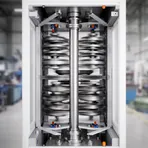
A central rod that turns and supports other machine parts

 1
9.6
1
9.6
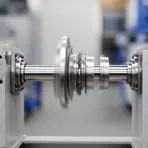
A metal rod that turns and holds machine parts
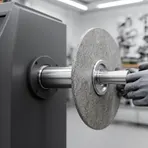
A metal rod in a machine that turns and holds larger parts like wheels

A rod that turns to move parts in a machine
Surface Forms
Etymology
Mandrel is the name for the metal shaft or axle that holds a part while it turns; think of it as the tool's inner spindle or 'spine' that supports and centers the rotating piece, which is why a mandrel keeps parts steady during machine work.