

magnetics
 3
7.2
3
7.2

- noun
- /məɡˈnɛtɪks/
- Specialized
- Researchers in magnetics are exploring new ways to improve magnetic resonance imaging technology.
Loading YouTube…
Watch on YouTubeWell, the Smithsonian just did a story which we can link to how great white sharks and all sharks might use magnetics to navigate.
- Well, the Smithsonian just did a story which we can link to how great white sharks and all sharks might use magnetics to navigate.
Examples
-
Micromachines come in many shapes and sizes but use only the actuating principles of electrostatics and magnetics, piezoelectrics, and thermal energy.
Academic text (1994) -
From this, he segued into a discussion of magnetics and the properties of stainless steel.
Fiction book (1999) -
Today I'd like to talk a bit about magnetics loss.
-
Well, the Smithsonian just did a story which we can link to how great white sharks and all sharks might use magnetics to navigate.
-
The machine's computer monitored every system and adjusted the flow of medicine, ultrasound, coherent healing light, and magnetics as needed.
Fiction book (1991) -
Thanks to some recent manufacturing advances, great sounding planar magnetics can be so small now that they will fit inside your ear canals.
-
Hall effect sensors are subject to stray field interference; perhaps some manufacturing or assembly problem resulted in inadequate shielding from stray magnetics?
Blog text (21) -
"In the big world, you can get greater energy densities out of magnetic fields than electrostatic fields," Allen said. "As engineers begin looking to develop large microactuators—which sounds like a contradiction in terms—they are finding that magnetics offers interesting solutions."
Academic text (1994) -
The study of magnetics helps scientists explain phenomena such as the Earth's magnetic field.
-
Understanding magnetics is crucial for developing advanced electric motors and magnetic levitation systems.
Synonyms
 1
4.9
1
4.9
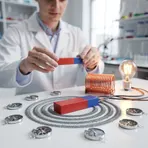
The area of science that studies how magnets work and their effects
Surface Forms
Morphology
Etymology
The word magnetics comes from magnet, which comes from an old Greek name for a stone from Magnesia that could 'pull' small pieces of iron. So, magnetics is the study of that 'pulling' force and how magnets work.