
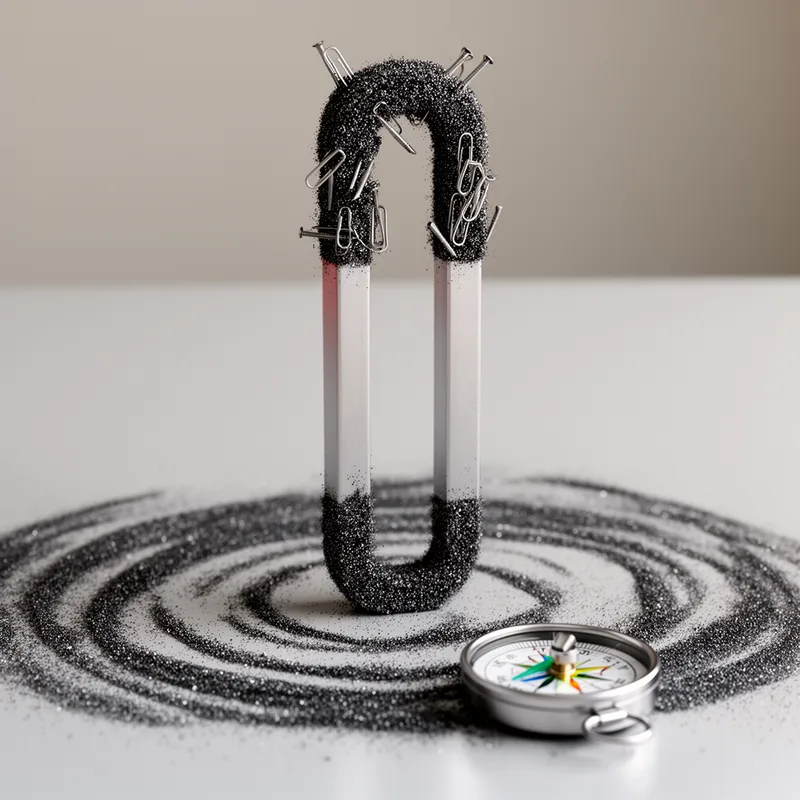
magnetic pole
- noun
- /mæɡˈnɛtɪk poʊl/
- Earth's South magnetic pole is in the north because all N magnetic poles point to it, right?
Loading YouTube…
Watch on YouTubeMaybe the grace of God, maybe I park on a spot that has electrical field, magnetic poles and it just soups my car up.
- Maybe the grace of God, maybe I park on a spot that has electrical field, magnetic poles and it just soups my car up.
Examples
-
When a magnet is suspended freely, one end will always point toward the magnetic pole of the Earth.
-
It's a pretty strong magnetic pole right there.
-
The poles, however, are always moving, and scientists can derive a lava flow's age by comparing its iron's alignment to the magnetic pole's position today.
Academic text (2004) -
The Earth's magnetic pole in the Arctic is constantly shifting due to changes in the planet's magnetic field.
-
Scientists study the magnetic poles to better understand the Earth's magnetic field and its effects on navigation.
Synonyms

 28
3.6
28
3.6

One of the two ends of a magnet or battery where force is strongest
Surface Forms
Morphology
The meaning 'either end of a magnet where the magnetic force is strongest' is directly derivable from combining 'magnetic' (relating to magnetism) with 'pole' (an end or extremity of a magnet). This is a straightforward adjective + noun composition that follows regular semantic modification and is cross-linguistically transparent, so a B1 learner who knows both constituents will readily understand it.
Etymology
Magnetic pole comes from the two ends of a magnet where the magnetic pull is strongest. The poles are the ends that pull iron and line up compass needles, so 'magnetic pole' means those strong ends of a magnet.