
macroinvertebrate


 1
8.2
- noun
- /ˌmækroʊɪnˈvɜːrtəbrət/
- Specialized
- Teachers learned to collect, identify, and categorize macroinvertebrates collected from a stream.
- benthic macroinvertebrates
- macroinvertebrate study
Examples
-
Macroinvertebrate feeding and burrowing strongly enhance the processing of organic material (Gullberg et al. 1997).
Academic text (2000) -
The macroinvertebrates were identified and quantified under stereomicroscopes and optical microscopes.
Academic text (2018) -
Macroinvertebrate refers to the group of animals without a defined backbone.
Academic text (2001) -
Teachers learned to collect, identify, and categorize macroinvertebrates collected from a stream.
Academic text (2001) -
The numerous species of amphipods in Lake Baikal represent one group of dominant benthic macroinvertebrates.
Academic text (2018) -
Water temperature is a major determinant of the stream age at which macroinvertebrate taxa colonize the new stream channels and hence the overall successional sequence.
Academic text (2007) -
Macroinvertebrate burrowing results in a deeper oxygenation of sediments, thereby extending the aerobic habitat of the sediment.
Academic text (2000) -
We expected that alterations in the physical-chemical variables would promote more pronounced changes in the phytoplankton and benthic macroinvertebrate assemblages, since variables such as temperature, nutrients, and sediments are very important in regulating these communities.
Academic text (2018) -
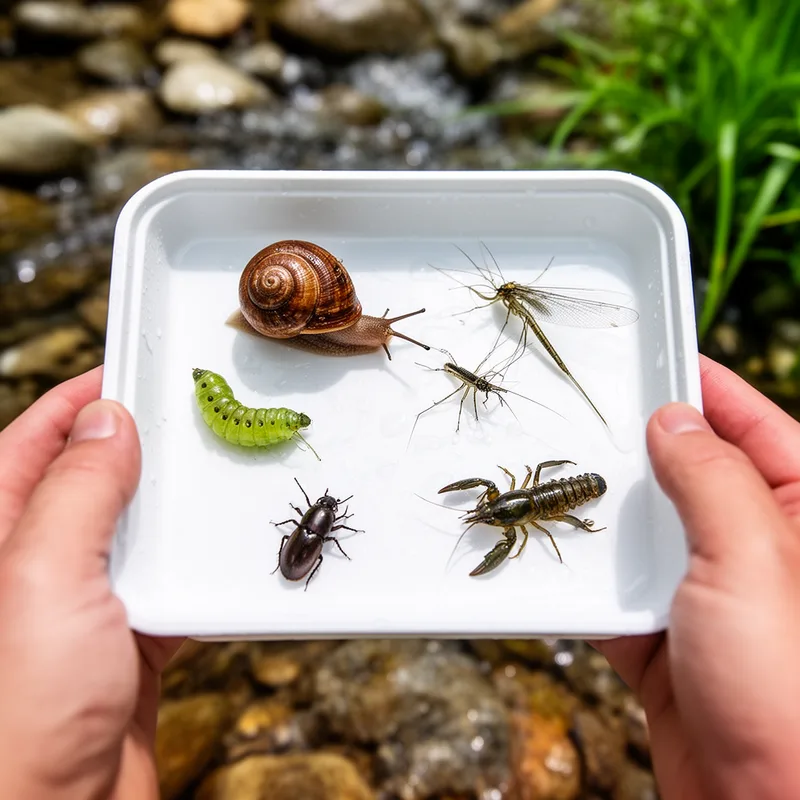
Stream-dwelling insects, worms, mollusks, and crustaceans are macroinvertebrates, visible creatures without backbones.
-
Mayflies are one of the most sensitive groups of macroinvertebrates.
Synonyms
 10
5.0
An animal that does not have a backbone, like an insect or worm
Surface Forms
Morphology
macroinvertebrate = invertebrate (semi-transparent) = macro + in + vertebr + ate
The meaning is mostly predictable as 'a large invertebrate', but in science it specifically means one large enough to be seen without a microscope.
Etymology
Macroinvertebrate combines macro- 'large' and invertebrate 'without a backbone'. So, a macroinvertebrate is an animal like an insect, worm, or snail that is big enough to see but has no backbone.