
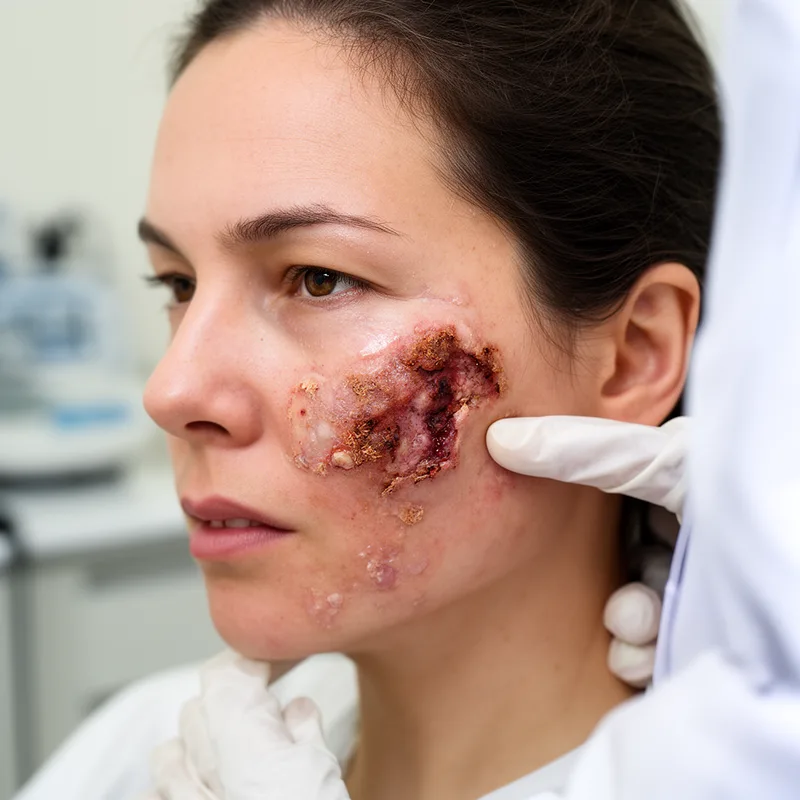
lupus vulgaris
- noun
- /ˈluːpəs ˈvʌɡərɪs/
- Archaic
- The doctor explained that lupus vulgaris can cause severe skin lesions on the face that heal slowly, often leaving deep scars.
Examples
-
Lupus vulgaris is a progressive form of cutaneous tuberculosis.
Academic text (2007) -
The key for the diagnosis of lupus vulgaris is the awareness of tuberculous etiology in any chronic ulcers.
Academic text (2007) -
However, it was not until the mid-nineteenth century that two specific skin diseases were separated as lupus erythematosus and lupus vulgaris.
Academic text (2007) -
These included very common diseases, such as acne vulgaris and verruca vulgaris, as well as now rarely diagnosed diseases, such as lupus vulgaris.
Academic text (2007) -
After noticing unusual skin marks that resulted from chronic tuberculosis, doctors diagnosed her with lupus vulgaris.
-
The treatment for lupus vulgaris typically requires medication to manage the symptoms and prevent further skin damage.
Surface Forms
Morphology
The parts give a partial clue: 'lupus' denotes a disease and 'vulgaris' signals a common/typical form, so a learner might infer 'a common type of lupus'. However, the specific meaning—a chronic cutaneous form of tuberculosis—is a specialized, historically medical sense and depends on Latin naming conventions and medical knowledge, so the exact sense is not derivable by a B1 learner who only knows the constituent words.
Etymology
Lupus vulgaris gets its name from old words: lupus meaning 'wolf' and vulgaris meaning 'common', because the skin sores looked as if something was 'eating away' the flesh like a wolf. That's why the name describes a long-lasting skin disease, a form of tuberculosis, that slowly makes deep scars.

