

lumberman's saw
- noun
- Archaic
- We needed two people to operate the lumberman's saw efficiently when cutting through thick logs.
Examples
-
The old loggers used a lumberman's saw to fell massive trees in the forest.
-
A traditional lumberman's saw requires teamwork and rhythm for smooth cutting.
-
The workers used a lumberman's saw to cut down the tree.
-
Do you know how to handle a lumberman's saw?
-
To cut large logs effectively, the team worked in unison with a lumberman's saw.
-
The lumbermen relied on a lumberman's saw to slice through the thick trunks with ease.
-
Using a lumberman's saw requires two people to ensure a steady and precise cut.
Synonyms

 54
1.0
54
1.0

A tool with a thin toothed blade used to cut wood or other materials
 1
9.6
1
9.6
A long saw with handles at both ends used by two people
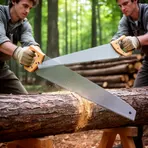
A large cutting tool with handles at both ends that two people use to cut wood
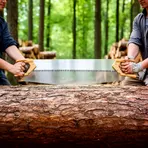
A long saw with handles at both ends used by two people to cut wood

A large saw used by two people to cut logs into planks, with one above and one below
How Big

Surface Forms
Morphology
lumberman's + saw
The noun is a straightforward combination of 'lumberman' (a worker who cuts timber) and 'saw' (a cutting tool), so its meaning—a saw used by lumbermen or for cutting logs—is directly derivable from the parts. The possessive/type-making construction is a common compositional pattern in English and other languages, making this readily comprehensible to a B1 learner who knows the constituent words.
Etymology
Lumberman's saw shows a simple image: a lumberman is a person who cuts trees, and a saw is a long blade that two people pull back and forth to cut a log. So, the name means 'a large saw used by two people to cut wood'.