

lowland burrowing treefrog
- noun
- Specialized
- After a heavy rain, the lowland burrowing treefrog emerges from its burrow to hunt for insects.
Examples
-
The lowland burrowing treefrog is often heard calling after summer rains in Arizona.
-
We spotted two lowland burrowing treefrogs near the edge of the grassy field last night.
-
Biologists are studying how the lowland burrowing treefrog survives in arid environments.
-
The lowland burrowing treefrog is a fascinating species.
-
Many lowland burrowing treefrogs live in the scrub forests.
-
The lowland burrowing treefrog can often be seen nestled among the grasses during the night.
-
In the southwestern United States, the lowland burrowing treefrog is known for its distinctive croaking sounds at night.
Synonyms
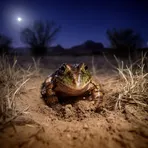
A burrowing frog active at night with a hard head that lives in southwestern United States grassy areas

A land frog that digs and lives underground at night with a hard head
Surface Forms
Morphology
The phrase is a straightforward descriptive compound: 'lowland' (in low-elevation areas) + 'burrowing' (digging/moving by making tunnels) + 'treefrog' (a frog associated with trees, itself transparently tree + frog). A B1 learner who knows the constituent words can readily infer this denotes a type of frog found in lowlands that burrows and is classified as a treefrog, so the meaning is compositional and predictable.
Etymology
Lowland burrowing treefrog gives a simple picture: lowland shows it lives in low, flat areas, burrowing means it 'digs' into the ground, and treefrog shows it is a type of treefrog. It has a very hard top of the head that it uses like a 'shovel' or a 'plug' when it digs or blocks its hole, so the name reminds you it is a ground-digging frog with a hard head.

