
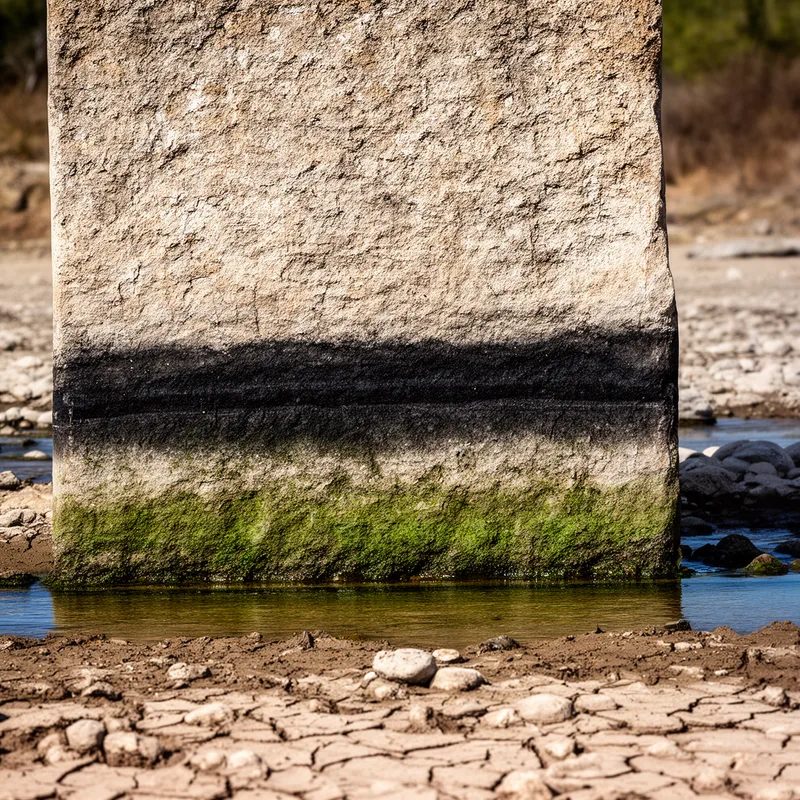
low-water mark
- noun
- /ˈloʊˌwɔːtər mɑrk/
- Make sure that there are at least six tide pools dispersed between the mean high-water and mean low-water marks.
Examples
-
The house was located just above the low-water mark of the river, so it often experienced flooding during heavy rains.
-
For example, Klugh found that the six tidal pools he examined were located between 3.5 and 19 ft above the mean low-water mark.
Academic text (1995) -
These cases helped set the stage for the Court's decision in South Carolina v. Baker, which was decided only three years after Garcia—at the low-water mark for the protection of states' interests under the Tenth Amendment.
Academic text (2017) -
The Convention recognizes every coastal state's right to establish a 12-mile territorial sea and beyond chart an exclusive economic zone (EEZ) extending up to 200 miles from the low-water mark or other baseline.
Academic text (2017) -
Scientists measured the low-water mark of the lake to assess changes in the water level over the years.
-
The company's profits hit a low-water mark last year, prompting a major restructuring to improve performance.
Synonyms

 130
1.0
130
1.0

The point when something is at its smallest level
 7
3.0
7
3.0
A mark on a ship or wall that shows how high the water reaches
 2
3.7
2
3.7
The lowest tide level at the shore or in a river
A visible line on the shore or on boats showing how high the tide reached

The lowest point something can reach
Antonyms

How High
286
1.0

- Specialized
- Specialized

 1
2.9
130
1.0
1
2.9
130
1.0
Surface Forms
Morphology
low-water + mark
The components 'low' + 'water' + 'mark' literally suggest a mark indicating when water is at a low level, so the idea of a 'lowest point' is derivable from the parts. However, the use of this physical image metaphorically to mean the 'worst or lowest point of a situation' requires a metaphorical mapping (knowledge of tide/level metaphors) that may not be fully predictable for a B1 learner without prior exposure.
Etymology
Low-water mark comes from a simple image: when a river or sea goes down, it leaves a clear mark on rocks showing the water's low level. So the phrase came to mean 'the lowest level' reached by the water or, by comparison, the lowest level of something else.