

low-birth-weight baby
 1
3.9
1
3.9

- noun
- /loʊ bɜrθ weɪt ˈbeɪbi/
- Specialized
- If you look where the big changes have come, let's say a decrease in infant mortality, a tremendous decrease because they have technologies now that can keep very low birth weight babies alive...
- premature and low-birth-weight baby
Loading YouTube…
Watch on YouTubeWe were able to reduce low birth weight babies by X amount.
- We were able to reduce low birth weight babies by X amount.
Examples
-
These pregnancies are less healthy, producing more premature, low-birth-weight babies.
Academic text (2009) -
There is a good discussion of these issues in this paper, which points out that the US actually does better with low birth weight babies than Canada, but has significantly more of them, which pushes up the average infant mortality rate.
Blog text (13) -
We were able to reduce low birth weight babies by X amount.
-
Even after controlling for mothers' age, education, and income, the proportion of low-birth-weight babies is roughly twice as high for blacks as for whites.
Academic text (1991) -
Stoltzfus explains that low-birth-weight babies are frequently iron deficient, a condition determined in large part by mothers' health.
Academic text (2005) -
Yes, and they're almost always low-birth-weight babies, frequently premature, higher incidence of crib death.
-
These researchers reported higher risks of preterm and low-birth-weight babies being born in the fall and winter to mothers living nearer the highest quintile traffic density.
Academic text (2008) -
In addition to neurological and other health effects, exposure to lead has been found to cause pregnant women to deliver prematurely and to have low-birth-weight babies (Lippmann, 2000).
Academic text (2002) -
Research has shown that smoking during pregnancy doubles the likelihood of having a low-birth-weight baby and increases the rate of infant mortality.
-
Twice as many black women give birth to low-birth-weight babies as white or Latina women in the U.S.
Synonyms

 1
3.9
1
3.9
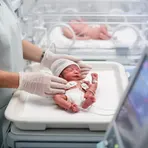
A baby born weighing less than 5.5 pounds or 2,500 grams

A baby born weighing under 2,500 grams or about 5 pounds 8 ounces
How Heavy

Surface Forms
Morphology
low-birth-weight + baby
The phrase is transparently built from the constituents 'low' + 'birth' + 'weight' modifying 'baby', so its meaning 'a baby born with a low birth weight' is directly inferable from the words. This compositional compound pattern is common cross-linguistically and in English, so a B1 learner who knows the individual words would readily understand the MWE's basic meaning (even if they do not know the exact 2,500 g threshold).
Etymology
Low-birth-weight baby comes from the simple idea of measuring babies at birth: if a baby's weight at birth is especially low, doctors call them a low-birth-weight baby. So the phrase means a baby 'weighing less than 5.5 pounds' who may need extra care.