

looking glass
 10
8.7
10
8.7

- noun
- /ˈlʊkɪŋ ɡlæs/
- Archaic
- After some time, she kneeled down and kissed the surface of the looking glass.
Examples
-
Let me use your looking glass.
-
One look at her reflection in the looking glass made Henrietta jump back in shock.
Fiction book (2000) -
A looking glass about two feet square.
-
I got up and went to the looking glass.
Academic text (2016) -
Take a look in the looking glass and you'll find your answer.
-
Her bleak eyes met in the reflection of the looking glass.
Fiction book (1991) -
Orlando looked himself up and down in a long looking glass, without showing any signs of discomposure, and went, presumably, to his bath.
Academic text (2003) -
As he walked out onto the terrace, Nix caught his reflection in a looking glass and stared.
Fiction book (1993) -
After untying the wide ribbons beneath her chin as she approached the looking glass, Susannah removed the bonnet and set it on the bureau top.
Fiction book (2001) -
She admired her hairstyle in the looking glass before leaving for the party.
Synonyms
 775
1.0
775
1.0
A smooth surface that shows a clear image of things
 67
9.9
67
9.9
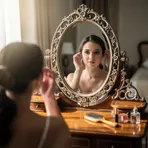
A mirror used to see your face when dressing
 3
2.1
3
2.1
A small mirror with a handle that you hold to see your face

 1
8.9
1
8.9
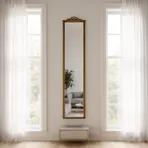
A tall narrow mirror on the wall between two windows
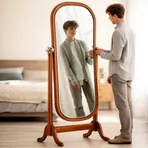
A tall full-length mirror in a frame that can tilt
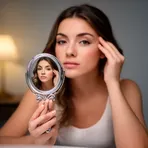
A small mirror with a handle for looking at your face
How Big

Surface Forms
Morphology
The meaning 'mirror' is directly derivable from combining 'looking' (the action of examining visually) with 'glass' (a mirror in this literary sense): a glass used for looking is a mirror. This is a straightforward noun-noun compound that follows productive compositional patterns (though slightly literary), so learners who know both constituents will readily infer the meaning.
Etymology
Looking glass comes from old mirrors made of glass that people used to see their faces. The name joins looking and glass because you literally 'look' into the 'glass', so it came to mean a 'mirror'.