
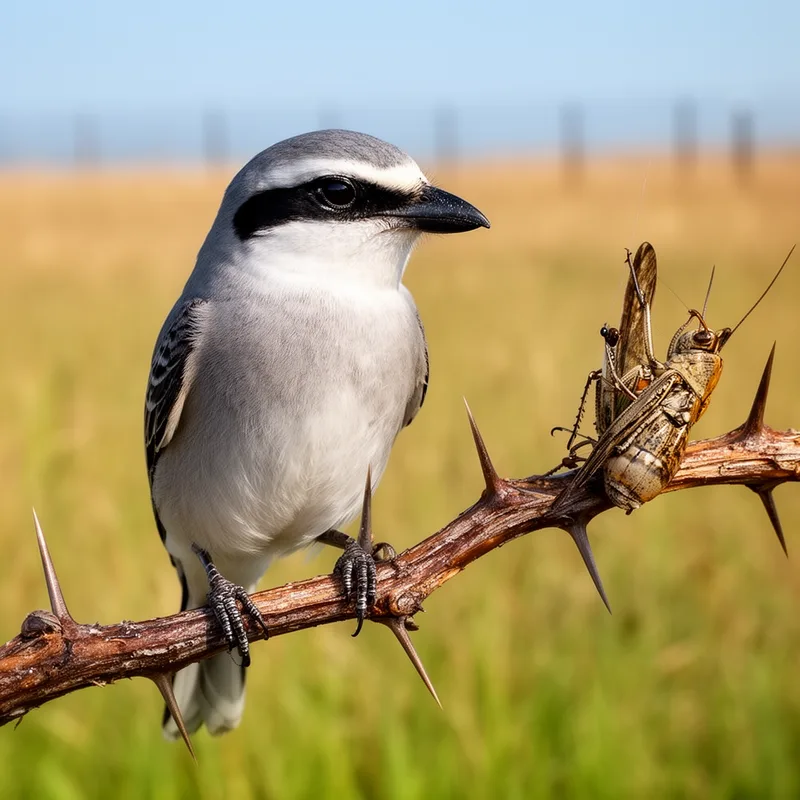
loggerhead shrike


 1
9.3
1
9.3
- noun
- /ˈlɔɡərˌhɛd ʃraɪk/
- Specialized
- The distinctive black eye bands of the loggerhead shrike make it easily recognizable in its natural habitat.
- loggerhead shrike population
Examples
-
And saw a loggerhead shrike from my hotel room in Natchitoches.
-
In the 1990s, the San Clemente Island loggerhead shrike population declined to as few as 14 individuals.
Academic text (2011) -
The wildlife biology group at Texas Tech also found loggerhead shrike populations significantly lower in imported fire ant territory.
Academic text (1994) -
Temple's group has linked the spread of fire ant colonies to the decline in the population of the loggerhead shrike, a grassland bird that is endangered in nine states.
Academic text (1994) -
While hiking in the southeastern United States, I spotted a magnificent loggerhead shrike perched on a fence post.
-
During my birdwatching trip, I was excited to see a loggerhead shrike among the various species in the open fields.
Synonyms

A small bird with a broad black mask across its eyes found in the southeastern United States
Surface Forms
Morphology
loggerhead + shrike
The noun 'shrike' clearly denotes a bird, and the compound reads as a descriptive species name; if a learner knows 'loggerhead' (historically meaning 'large-headed' or as an established name) they can infer it refers to a shrike with a notably large head. However, 'loggerhead' is low-frequency and here lacks a dictionary definition, so the meaning is only partially predictable for an average B1 learner rather than fully compositional.
Etymology
Loggerhead shrike comes from two strong images: loggerhead once meant a thick block of wood or a big head, and shrike is a small bird that 'impales' its prey on thorns. So the name helps you picture a strong-headed bird with a hooked beak and fierce habits.