

locomotive engineer
- noun
- /ˌloʊkəˈmoʊtɪv ˌɛnʤɪˈnɪr/
- US
- Being a locomotive engineer requires extensive training and a deep understanding of railway systems.
Examples
-
As a locomotive engineer, he is responsible for ensuring the train runs safely and on time.
-
According to the FRA, a locomotive engineer could operate a train for as many as 432 hours in a single month, or the equivalent of more than 14 hours a day, and still be operating within current federal rules.
Academic text (2007) -
Financial difficulties following the deaths of his parents forced him to leave Dresden Polytechnical School, where he had planned to become a locomotive engineer, and to return home and begin studies in natural science at the University of Leipzig.
Academic text (1990) -
In addition to storing data needed to diagnose locomotive faults, the system alerts the operator and locomotive engineers to critical events, such as an overheating engine, that need immediate action.
Academic text (1995) -
The locomotive engineer skillfully navigated the steep tracks as the train climbed the mountain.
Synonyms

 37
2.7
37
2.7

A person who drives a train
 1
3.4
1
3.4
A person who drives a train and controls its engine


 1
3.3
1
3.3
A person who controls a train's engine
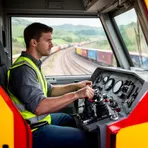
A person who drives a train engine
Surface Forms
Morphology
The meaning is directly and compositionally derived from the constituents: 'locomotive' (railway vehicle) + 'engineer' (operator) yields 'a person who operates a locomotive.' This compound/nominal modifier pattern is common cross-linguistically and follows straightforward English word-building, so a B1 learner who knows both words will readily understand it.
Etymology
Locomotive engineer: The name locomotive engineer comes from early steam trains where the word locomotive meant the moving engine and engineer was the person who looked after the engine and its controls. So the phrase came to mean 'a person who operates a railway locomotive' or simply 'train driver'.