
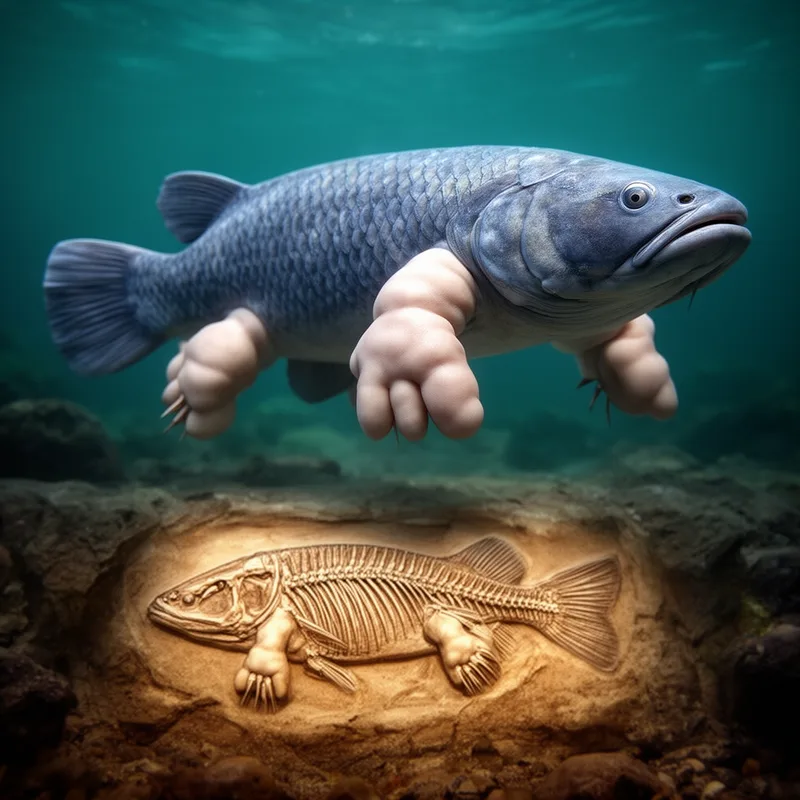
lobe-finned fish
- noun
- /ˈloʊbˌfɪnd fɪʃ/
- Specialized
- Scientists were surprised to discover a lobe-finned fish alive off the coast of South Africa.
Examples
-
The lobe-finned fish is an important group in evolutionary biology.
-
Scientists believe that lobe-finned fish played a crucial role in the evolution of land animals.
-
Fossils of lobe-finned fish provide crucial evidence for understanding the evolution of land vertebrates.
-
The coelacanth is a rare living example of a lobe-finned fish.
-
Did you know that the lobe-finned fish includes the coelacanth?
-
The discovery of ancient bones suggests that lobe-finned fish were among the first creatures to develop limbs.
-
Lobe-finned fish, like the coelacanth, are fascinating reminders of our planet's evolutionary history.
Synonyms

A mostly extinct fish with fleshy, lobed fins that look like small limbs

An extinct fish with thick fins that look like limbs and are known from fossils
Surface Forms
Morphology
lobe-finned + fish
The phrase is compositionally built: 'lobe-finned' denotes having lobed (lobe-shaped) fins and 'fish' names the animal, so a learner who knows the constituent meanings can infer 'a fish with lobed/fleshy fins.' Although it is a technical biological term for a taxonomic group, its meaning is transparently derived from the parts and follows regular English compounding patterns.
Etymology
Lobe-finned fish: The name lobe-finned fish comes from their thick, rounded fins: the word lobe means a rounded part and finned shows they have fins that are fleshy and a bit like small arms. Because these fins look 'limb-like', the name helps explain why these fish are important for showing how early animals moved from water onto land.

