

liturgical
 16
8.5
16
8.5

- adjective
- /lɪˈtɜrdʒɪkəl/
- Many students study the liturgical calendar to understand the important festivals of the church.
- liturgical renewal
- liturgical function
- liturgical calendar
Loading YouTube…
Watch on YouTubeStill, nuns liturgical books supply important clues for reconstructing, even if only partially, the features and uses of these objects.
- Still, nuns liturgical books supply important clues for reconstructing, even if only partially, the features and uses of these objects.
Examples
-
Matilda's anniversary was recorded alongside those of the abbots in a twelfth-century liturgical calendar.
Academic text (1999) -
A bell rings to announce the liturgical hours that divide their day into these types of prayer.
Fiction book (2002) -
Do you sing any liturgical music?
-
Your prophecy will be recorded into our liturgical texts.
-
By the Middle Ages, many of these celebrations were associated with the Catholic liturgical calendar.
Academic text (1999) -
The brethren divided from us also carry out many liturgical actions of the Christian religion.
Academic text (2013) -
For the first time in history, Christians in the English-speaking world are using common liturgical texts.
Academic text (2013) -
Signs of a greater family orientation, even in Catholic social and liturgical experience, had begun to emerge by 1955.
Academic text (1994) -
Might the origin of some doctrines and liturgical practices be revealed to have non-Christian sources?
Academic text (1992) -
The church traditionally called upon Catholics to organize themselves separately in social and liturgical functions.
Academic text (1994)
Synonyms
 60
5.7
60
5.7
Formal and traditional in style, like events with set actions
 3
4.5
3
4.5
Relating to or done as part of a ceremony
Compounds
- Literature
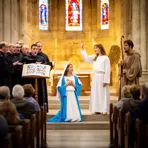
A play about Bible stories performed in a church on holy days, usually sung in Latin
How Religious

Surface Forms
Morphology
Etymology
The word liturgical comes from the Greek leitourgia, which means 'public service' or 'work for the people', and it is the same root as the word liturgy. So liturgical describes things used in an official worship service, like special music or clothes, because they belong to that public 'service'.