
lithographically


 1
8.1
- adverb
- /ˌlɪθəˈɡræfɪkli/
- Specialized
- The engineer created a series of devices that were lithographically printed to ensure precise detail.
Examples
-
The process of choice to meet the requirement of precise shape and dimension, particularly for thick conductors, is electroplating through a lithographically defined mask.
Academic text (1998) -
In contrast with naturally occurring atoms, artificial atoms can be lithographically designed to have specific characteristics, such as a large dipole moment or particular transition frequencies.
Academic text (2005) -
Such dissolution promotion is required to make DMA work lithographically.
Academic text (2001) -
9. Kershner, R.J. et al. Placement and orientation of individual DNA shapes on lithographically patterned surfaces. Nature Nanotechnology 4, 9 (Aug. 2009), 557-561.
Academic text (2011) -
A doped silicon wafer provides the gate electrode, thermally grown silicon dioxide serves as the dielectric layer, and lithographically patterned gold forms the source and drain.
Academic text (2006) -
The artist used lithographically produced images to add depth to his work.
-
Each component was lithographically designed to fit seamlessly into the overall assembly.
Surface Forms
Morphology
lithographically = lithographic (transparent) = lithograph + ic + ally
Formed by the adjective 'lithographic' + the regular adverbial suffix '-ally', so the adverbial meaning is directly derived.
Etymology
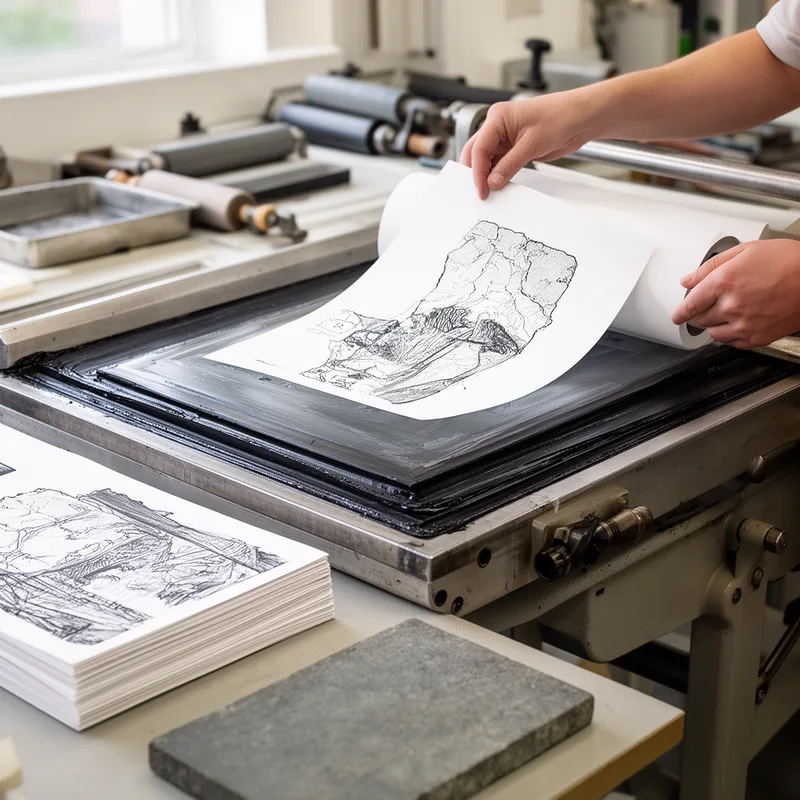
Lithographically comes from Greek parts litho- meaning 'stone' and -graphy meaning 'writing' or 'drawing'. Long ago, artists drew on flat stones to make prints, so to do something lithographically is to make or print it in that old 'stone-writing' way.