
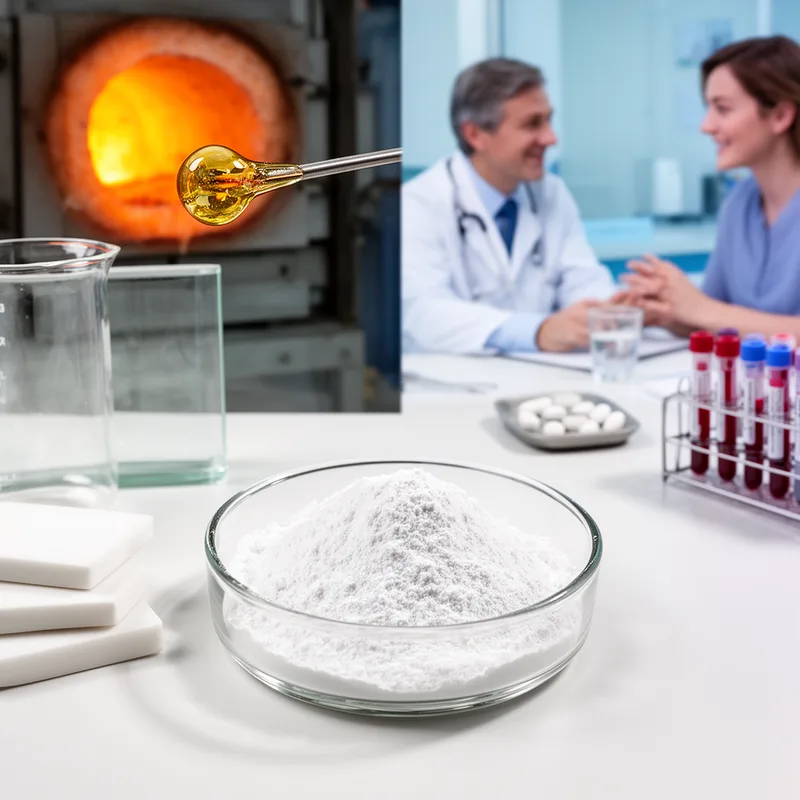
lithium carbonate
 1
5.8
1
5.8

- noun
- /ˈlɪθiəm ˈkɑːrbəneɪt/
- Specialized
- Many patients benefit from lithium carbonate treatment.
Examples
-
Patients taking lithium carbonate must have their blood levels monitored regularly.
-
The doctor prescribed lithium carbonate to help stabilize his mood swings.
-
Manufacturers use lithium carbonate in the production of specialty glass and ceramics.
-
The doctor prescribed lithium carbonate for her bipolar disorder.
-
The manufacturer uses lithium carbonate to produce high-quality ceramics.
-
Doctors prescribe lithium carbonate as a treatment for patients with bipolar disorder.
-
In the lab, we analyzed the purity of lithium carbonate used for the glass-making process.
Synonyms
A white chemical used to make glass and as a medicine for some mood problems

A white medicine with lithium used to treat bipolar disorder

A medicine with lithium that helps keep moods stable in people with bipolar disorder and some types of depression
Surface Forms
Morphology
The term is compositionally transparent: it denotes the carbonate salt of lithium, which a learner who knows 'lithium' (the metal) and 'carbonate' (the CO3(2-) salt) can reasonably infer. While specific uses (e.g., pharmaceutical applications) are domain-specific, the basic chemical identity is directly derivable from the constituents and is cross-linguistically regular.
Etymology
Lithium carbonate is named from its two parts: lithium (the metal) and carbonate (a type of salt related to carbon). Together they form a stable white powder that is used in making glass and ceramics and, in carefully measured doses, as a medicine to 'stabilize mood', so the name tells you it is the salt form of lithium used for those purposes.